From Dr Deb
Insights from the modern TCM Doctor.
No spam, unsubscribe anytime.
Insomnia and the Nervous System: Why You Can't Force Sleep
A patient recently asked Dr. Nishi Bhopal to fix his sleep with a purchase. "Just tell me what mattress to get," he said, ready to "throw $5,000 at this problem." Her answer: take a step back, because sleep had never made his priority list. She sees it all over the Bay Area: engineers working half the night, then shopping their way toward rest.
Dr. Nishi is a psychiatrist and sleep medicine doctor who folds Ayurveda into her practice, and my guest on our podcast, Puzzle Exchange. I invited her because we treat the same patients from two directions: the ones staring at the ceiling at 3am. We kept landing on one conclusion. You cannot buy sleep, and you cannot force it. Sleep comes when your body believes it is safe.

Insomnia Is a Nervous System That Doesn't Feel Safe
The simplest thing Nishi said is the one I keep quoting: "our body knows how to sleep." When sleep stops coming night after night, the trouble is usually a system standing guard, tensed for a threat that never arrives.
Sleeping is the most vulnerable thing a body does. In her words: "That nervous system is saying that you're not safe, and sleep is vulnerable. So we have to calm the nervous system down so that your body can feel safe, and then sleep will come."
Chinese medicine arrived at the same reading two thousand years earlier. The classical account is 心藏神, the Heart houses the spirit: a settled spirit sleeps, and insomnia is a spirit that will not settle. That is the TCM lens, not a lab result, and it gives the same instruction: settle the system first. It is why the classic sleep points are calm-the-spirit points.
The Harder You Chase Sleep, the Faster It Runs
Once sleep goes bad, most of us start working at it. Nishi calls this sleep effort: melatonin, then magnesium, then ashwagandha, then a tracker or two. The effort itself is arousal; your body reads all that trying as evidence that something is wrong.
She reached for an old line I now repeat to patients: "Sleep is like a cat. It only comes to you when you ignore it."
Melatonin, which half my patients take, deserves one clarification. In Nishi's words, "It's not a sleeping pill. It's a circadian regulation agent." It nudges your body clock's timing, and sleep guidelines do not endorse it as a hypnotic. Her framing for the whole supplement shelf: "they are a support, but they're not a solution."
Your Sleep Score Is Measuring Almost Nothing
Patients arrive in Nishi's office worried they "only got 10% REM sleep." Sleep stages are defined by EEG brainwaves, which no watch or ring measures; for staging, she says, "it's a useless kind of metric." In a 2021 head-to-head test in the journal SLEEP, seven consumer devices missed 30 to 50 percent of deep and REM sleep on average. Sleep physicians coined a name, orthosomnia, for chasing a perfect score until it wrecks the sleep. The score becomes the threat.
I meet the mirror image in clinic: the ring says they slept fine, they feel wrung out, and their pulse and tongue say stress. The body keeps its own score.
A Steady Schedule Beats a Perfect Eight Hours
Two tracker numbers survive: how much you sleep, and how regularly. Hold both lightly; the second matters more.
Eight hours is only an average, with wide, healthy variation on either side, and sleep need drops with age. I tell my patients we are like batteries: some recover on a quick charge, some need the long overnight kind. Chinese medicine never named a universal number either; its old standard is waking naturally, restored.
In a 2024 UK Biobank analysis of 60,977 people, a consistent schedule predicted living longer better than duration did; adding duration to the model added nothing. A steady, boring, repeatable bedtime is one of the most credible safety signals you can send your body.
Your 3am Wake-Up Is Older Than You Think
Waking at 2 or 3am, Nishi wants you to know, is part of a normal sleep cycle, arguably even evolutionary. For most of human history, a brief wake in the small hours was an advantage. Scan the camp, confirm no tiger, check that the babies are breathing, drift back down. Sleep architecture cooperates: deep sleep front-loads the first half, the second runs lighter and REM-rich, so a 3am surfacing rises out of shallower water.
Chinese medicine mapped those hours centuries ago with the organ clock: 1 to 3am belongs to the Liver, 3 to 5am to the Lung, and the classics say blood returns to the Liver when you lie down. Through that lens, waking at the same dark hour every night is yang rising that a depleted yin cannot yet anchor. The comfort lands either way: your 3am has been on the map for centuries.
What keeps you up at 3am is usually the panic that follows: the clock check, the math on tomorrow. The surfacing is old news to your species. Treat it as ordinary and you hand your body evidence that nothing is wrong.
The Day Decides How You Sleep at Night
Racing thoughts at midnight are often the day's backlog. If the mind gets no quiet for sixteen hours, it schedules its meeting at 2am. Nishi's prescription is white space: "little pockets of time where there's no stimulation, no phone, no podcast, no TV, no email, just quiet silence." A short walk counts. So do a few slow breaths.
The bedroom talks to the same system. Keep it cool, dark, quiet, and uncluttered; a laundry pile reads as a to-do list, and as Nishi says, "your bedroom should be your sanctuary." Two feng shui rules I grew up with, less hocus pocus than startle-proofing: no mirror facing the bed, because at 3am a moving reflection with wild hair looks like an intruder, and no heavy beam overhead, a low hum of pressure.
The Two Wrist Points I Teach for Racing-Mind Nights
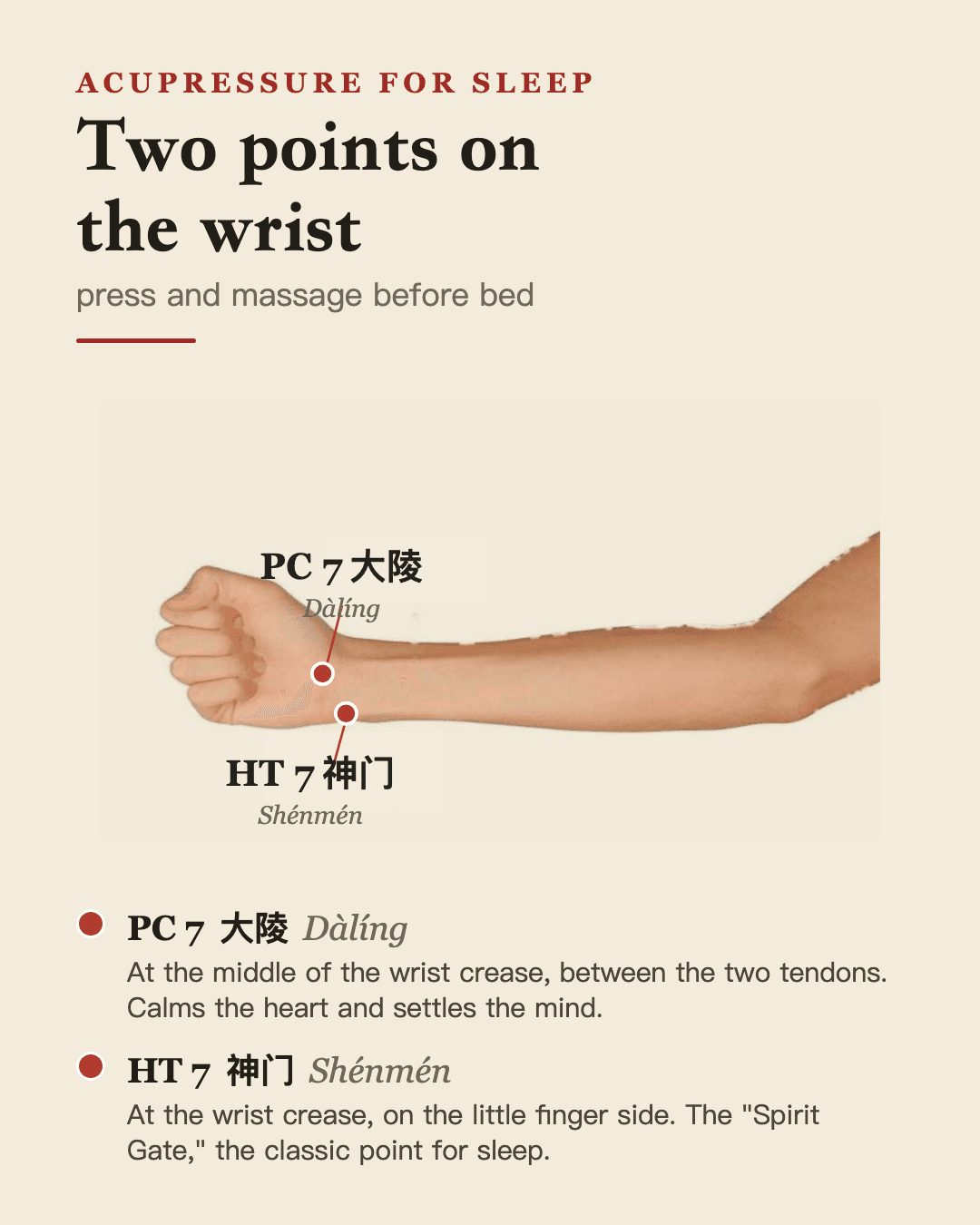
This is the Heart-and-spirit logic turned into homework. The classic sleep points in TCM are 安神 (calm the spirit) points, and my two favorites for self-care sit side by side on the inner wrist. PC7, 大陵 Dàlíng, at the midpoint of the palm-side wrist crease, on the Pericardium channel, the Heart's shield in TCM, nicknamed the sleep point on the hand. HT7, 神门 Shénmén, on the same crease toward the little finger, on the Heart channel itself; the name translates as Spirit Gate, the classic point for a mind that will not switch off.

Cup your hand slightly and two tendons stand up on your inner wrist. PC7 is in the dip between them, dead center on the crease. HT7 is at the little-finger edge of the same crease, in the hollow just inside the tendon there. Press each with your thumb, slowly, one to two minutes per side, to mild soreness or heaviness. Gentle pressure only; stop if it hurts. Try it tonight at lights-out, or at 3am with your eyes closed. Free, no gear, $5,000 cheaper than a mattress.

In the clinic, needle acupuncture is associated with better self-reported sleep: a 2025 meta-analysis of ten sham-controlled trials (757 patients) found meaningfully better subjective sleep quality than sham needling, where the landmark 2012 Cochrane review was inconclusive. One distinction matters. Those results come from practitioner-administered acupuncture, a different thing from pressing your own wrist. The wrist homework is the gentle, free cousin, a way to practice calming your system, without a clinical trial yet behind it.

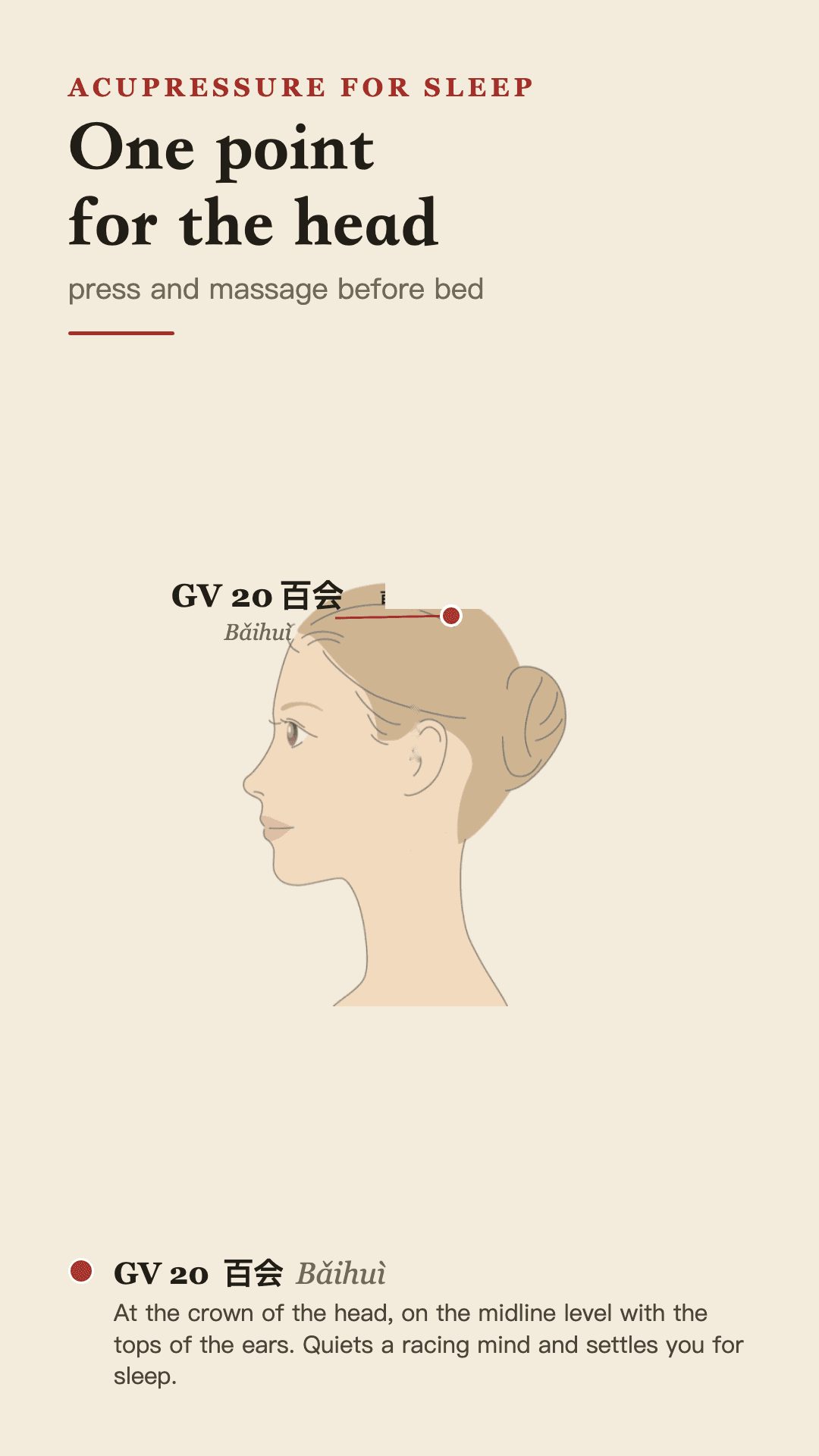
The points belong to a family of slow, hands-on downshifts: scalp massage wherever it feels tight, or abhyanga from Nishi's Ayurvedic tradition, slow oil strokes down the limbs. The technique matters less than the slowing down it forces. If sleeplessness is severe or persistent, self-care is not a substitute for getting evaluated.
Entrenched Insomnia Is Fixable, Often in Weeks
Nishi's clinical definition: insomnia means trouble falling or staying asleep at least three nights a week, for three months or more, with daytime impairment. A rough stretch in a hard month is normal sleep doing normal things.
Also hers: "Insomnia is a symptom. It's not necessarily a diagnosis." Sleep apnea can look like it; so can thyroid trouble. Low iron is worth asking your doctor about, especially for women, whose ferritin runs far lower and who get restless legs about twice as often.
When insomnia has dug in, the gold-standard first-line treatment is CBT-I, cognitive behavioral therapy for insomnia: the field's strongest guideline recommendation, no medication, benefits that outlast treatment where a pill works only while you take it. Nishi pairs it with gentler acceptance-based therapy and described patients arriving with "20 years of trying everything." "And then within two or three weeks, they're sleeping again."
Three Traditions, One Instruction
Sleep psychiatry, Chinese medicine, and Ayurveda arrive at the same instruction: the body sleeps when it feels safe. Your job is to hand your body evidence of safety: a schedule it can predict, pockets of quiet in the day, a room with nothing to startle at, a slow thumb on the wrist at 3am.
If you are in San Francisco and curious whether acupuncture belongs in your sleep toolkit, I would love to meet you: book a free strategy consult and we will look at your nights together. The full conversation with Dr. Nishi Bhopal is on our podcast, Puzzle Exchange.
A patient recently asked Dr. Nishi Bhopal to fix his sleep with a purchase. "Just tell me what mattress to get," he said, ready to "throw $5,000 at this problem." Her answer: take a step back, because sleep had never made his priority list. She sees it all over the Bay Area: engineers working half the night, then shopping their way toward rest.
Dr. Nishi is a psychiatrist and sleep medicine doctor who folds Ayurveda into her practice, and my guest on our podcast, Puzzle Exchange. I invited her because we treat the same patients from two directions: the ones staring at the ceiling at 3am. We kept landing on one conclusion. You cannot buy sleep, and you cannot force it. Sleep comes when your body believes it is safe.

Insomnia Is a Nervous System That Doesn't Feel Safe
The simplest thing Nishi said is the one I keep quoting: "our body knows how to sleep." When sleep stops coming night after night, the trouble is usually a system standing guard, tensed for a threat that never arrives.
Sleeping is the most vulnerable thing a body does. In her words: "That nervous system is saying that you're not safe, and sleep is vulnerable. So we have to calm the nervous system down so that your body can feel safe, and then sleep will come."
Chinese medicine arrived at the same reading two thousand years earlier. The classical account is 心藏神, the Heart houses the spirit: a settled spirit sleeps, and insomnia is a spirit that will not settle. That is the TCM lens, not a lab result, and it gives the same instruction: settle the system first. It is why the classic sleep points are calm-the-spirit points.
The Harder You Chase Sleep, the Faster It Runs
Once sleep goes bad, most of us start working at it. Nishi calls this sleep effort: melatonin, then magnesium, then ashwagandha, then a tracker or two. The effort itself is arousal; your body reads all that trying as evidence that something is wrong.
She reached for an old line I now repeat to patients: "Sleep is like a cat. It only comes to you when you ignore it."
Melatonin, which half my patients take, deserves one clarification. In Nishi's words, "It's not a sleeping pill. It's a circadian regulation agent." It nudges your body clock's timing, and sleep guidelines do not endorse it as a hypnotic. Her framing for the whole supplement shelf: "they are a support, but they're not a solution."
Your Sleep Score Is Measuring Almost Nothing
Patients arrive in Nishi's office worried they "only got 10% REM sleep." Sleep stages are defined by EEG brainwaves, which no watch or ring measures; for staging, she says, "it's a useless kind of metric." In a 2021 head-to-head test in the journal SLEEP, seven consumer devices missed 30 to 50 percent of deep and REM sleep on average. Sleep physicians coined a name, orthosomnia, for chasing a perfect score until it wrecks the sleep. The score becomes the threat.
I meet the mirror image in clinic: the ring says they slept fine, they feel wrung out, and their pulse and tongue say stress. The body keeps its own score.
A Steady Schedule Beats a Perfect Eight Hours
Two tracker numbers survive: how much you sleep, and how regularly. Hold both lightly; the second matters more.
Eight hours is only an average, with wide, healthy variation on either side, and sleep need drops with age. I tell my patients we are like batteries: some recover on a quick charge, some need the long overnight kind. Chinese medicine never named a universal number either; its old standard is waking naturally, restored.
In a 2024 UK Biobank analysis of 60,977 people, a consistent schedule predicted living longer better than duration did; adding duration to the model added nothing. A steady, boring, repeatable bedtime is one of the most credible safety signals you can send your body.
Your 3am Wake-Up Is Older Than You Think
Waking at 2 or 3am, Nishi wants you to know, is part of a normal sleep cycle, arguably even evolutionary. For most of human history, a brief wake in the small hours was an advantage. Scan the camp, confirm no tiger, check that the babies are breathing, drift back down. Sleep architecture cooperates: deep sleep front-loads the first half, the second runs lighter and REM-rich, so a 3am surfacing rises out of shallower water.
Chinese medicine mapped those hours centuries ago with the organ clock: 1 to 3am belongs to the Liver, 3 to 5am to the Lung, and the classics say blood returns to the Liver when you lie down. Through that lens, waking at the same dark hour every night is yang rising that a depleted yin cannot yet anchor. The comfort lands either way: your 3am has been on the map for centuries.
What keeps you up at 3am is usually the panic that follows: the clock check, the math on tomorrow. The surfacing is old news to your species. Treat it as ordinary and you hand your body evidence that nothing is wrong.
The Day Decides How You Sleep at Night
Racing thoughts at midnight are often the day's backlog. If the mind gets no quiet for sixteen hours, it schedules its meeting at 2am. Nishi's prescription is white space: "little pockets of time where there's no stimulation, no phone, no podcast, no TV, no email, just quiet silence." A short walk counts. So do a few slow breaths.
The bedroom talks to the same system. Keep it cool, dark, quiet, and uncluttered; a laundry pile reads as a to-do list, and as Nishi says, "your bedroom should be your sanctuary." Two feng shui rules I grew up with, less hocus pocus than startle-proofing: no mirror facing the bed, because at 3am a moving reflection with wild hair looks like an intruder, and no heavy beam overhead, a low hum of pressure.
The Two Wrist Points I Teach for Racing-Mind Nights
This is the Heart-and-spirit logic turned into homework. The classic sleep points in TCM are 安神 (calm the spirit) points, and my two favorites for self-care sit side by side on the inner wrist. PC7, 大陵 Dàlíng, at the midpoint of the palm-side wrist crease, on the Pericardium channel, the Heart's shield in TCM, nicknamed the sleep point on the hand. HT7, 神门 Shénmén, on the same crease toward the little finger, on the Heart channel itself; the name translates as Spirit Gate, the classic point for a mind that will not switch off.

Cup your hand slightly and two tendons stand up on your inner wrist. PC7 is in the dip between them, dead center on the crease. HT7 is at the little-finger edge of the same crease, in the hollow just inside the tendon there. Press each with your thumb, slowly, one to two minutes per side, to mild soreness or heaviness. Gentle pressure only; stop if it hurts. Try it tonight at lights-out, or at 3am with your eyes closed. Free, no gear, $5,000 cheaper than a mattress.

In the clinic, needle acupuncture is associated with better self-reported sleep: a 2025 meta-analysis of ten sham-controlled trials (757 patients) found meaningfully better subjective sleep quality than sham needling, where the landmark 2012 Cochrane review was inconclusive. One distinction matters. Those results come from practitioner-administered acupuncture, a different thing from pressing your own wrist. The wrist homework is the gentle, free cousin, a way to practice calming your system, without a clinical trial yet behind it.

The points belong to a family of slow, hands-on downshifts: scalp massage wherever it feels tight, or abhyanga from Nishi's Ayurvedic tradition, slow oil strokes down the limbs. The technique matters less than the slowing down it forces. If sleeplessness is severe or persistent, self-care is not a substitute for getting evaluated.
Entrenched Insomnia Is Fixable, Often in Weeks
Nishi's clinical definition: insomnia means trouble falling or staying asleep at least three nights a week, for three months or more, with daytime impairment. A rough stretch in a hard month is normal sleep doing normal things.
Also hers: "Insomnia is a symptom. It's not necessarily a diagnosis." Sleep apnea can look like it; so can thyroid trouble. Low iron is worth asking your doctor about, especially for women, whose ferritin runs far lower and who get restless legs about twice as often.
When insomnia has dug in, the gold-standard first-line treatment is CBT-I, cognitive behavioral therapy for insomnia: the field's strongest guideline recommendation, no medication, benefits that outlast treatment where a pill works only while you take it. Nishi pairs it with gentler acceptance-based therapy and described patients arriving with "20 years of trying everything." "And then within two or three weeks, they're sleeping again."
Three Traditions, One Instruction
Sleep psychiatry, Chinese medicine, and Ayurveda arrive at the same instruction: the body sleeps when it feels safe. Your job is to hand your body evidence of safety: a schedule it can predict, pockets of quiet in the day, a room with nothing to startle at, a slow thumb on the wrist at 3am.
If you are in San Francisco and curious whether acupuncture belongs in your sleep toolkit, I would love to meet you: book a free strategy consult and we will look at your nights together. The full conversation with Dr. Nishi Bhopal is on our podcast, Puzzle Exchange.
From Dr Deb
Insights from the modern TCM Doctor.
No spam, unsubscribe anytime.
Ready to discuss your case?
Book a free 15-minute strategy session with Dr. Deb