Somewhere around day three of a long weekend, most of us eat a meal we did not need. The plate you couldn't finish but finished anyway. The burger someone's uncle grilled just for you. The cold beer sweating in your hand, and then the couch.
Then comes the morning after. Heavy, foggy, your stomach still working overtime on food from twelve hours ago. Digestive weirdness, in full bloom.
Two reflexes kick in here. One says juice cleanse, starting Monday. The other shrugs and calls it the price of a good time. Skip both. What happened this weekend is a load problem, and Chinese medicine has been managing exactly this load for about two thousand years.
Your body's kitchen crew just worked a double shift
In Traditional Chinese Medicine, digestion belongs to a paired system called the Spleen and Stomach, 脾胃 pí wèi. Quick clarification, because it trips everyone up: TCM's Spleen is a functional system, the part of you that takes food in and transforms it into usable energy. It covers far more than the anatomical organ your doctor could point to on a scan. I tell patients to picture the body's kitchen crew.
A feast alone puts that crew on a double shift. Now stack on what a July weekend actually delivers. Greasy grilled food. Alcohol. Iced drinks going down all afternoon. Meals at random hours, with a long drive somewhere in the middle.
The classical texts say the Spleen hates dampness (脾恶湿 pí wù shī) and works best warm and on a rhythm. Rich, greasy food and alcohol are exactly the inputs said to generate 湿 shī, dampness, a kind of internal bog. Ice makes the whole operation run colder and slower.
My translation: you cold-and-greased your kitchen crew, and now they're wading through mud. That mud is the heaviness, the bloat, the foggy head, the sluggish next morning.
None of this is a new observation. The Huangdi Neijing 黄帝内经, the Yellow Emperor's Inner Classic and roughly two thousand years old, opens with the advice 食饮有节 shí yǐn yǒu jié: eat and drink with moderation. The same passage names 以酒为浆 yǐ jiǔ wéi jiāng, treating wine like water, among the habits that wear a body out early. Holiday weekends are not a modern invention.
Moderation is a timing skill, not a punishment
If you keep one idea from this post, keep this one: 八分饱 bā fēn bǎo. Eat until you are about eight-tenths full. Then stop.
Why eight-tenths? Because fullness registers on a delay. By the time your brain announces "full," the crew downstairs is already over capacity. Eating to eight-tenths is mostly a pacing skill: stop a little sooner, let the signal catch up.
I love this principle because there is no punishment in it. A Qing dynasty longevity text by Mǎ Qí 马齐, the Lùdì Xiānjīng 陆地仙经, put a whole day's eating in one line: breakfast light and early, lunch fuller, dinner small. And Chinese grandmothers still say 饭吃八分饱,无病活到老 fàn chī bā fēn bǎo, wú bìng huó dào lǎo. Eat to eight-tenths full, live to old age without illness. That's a folk saying, and it has aged well.
Five things that actually help before Monday
No cleanse, no supplement haul. Mostly food timing.
Eat to eight-tenths, slowly. Put the fork down between bites. The fullness signal lags behind the food, so pace decides everything.
Go warm over iced. Room-temperature or warm drinks with meals, and warm water or tea between alcoholic drinks. Stop pouring cold on the crew.
Leave three hours between the last big plate and lying down. In one study comparing reflux patients with matched controls, eating within three hours of bedtime carried about 7.5 times the odds of reflux versus waiting four hours or more. The graze-then-couch pattern is exactly the one to break.
Walk after you eat, even five minutes. A 2022 meta-analysis found light walking after meals blunted the post-meal blood sugar spike by roughly 17 percent compared with staying seated, and as little as two to five minutes helped. Your grandparents' after-dinner stroll was real medicine.
Give the crew a gentle morning. The day after a feast, eat warm and simple. Congee if you grew up with it, oatmeal or brothy soup if you didn't. Skip the second heavy round and let the system reset.
Three points you can press yourself
You also carry a small toolkit on your own body. These are the three acupressure points I teach for exactly this weekend, each matched to a different flavor of post-feast misery. The point cards in this post mark each spot on real anatomy.
Technique, for all three: press firmly but gently, in slow small circles, 30 to 60 seconds, breathing slowly. Do both sides where there are two. It should feel relieving. If it hurts, lighten up or stop. And anything severe or rapidly getting worse deserves prompt medical care first.
Local test booking. No email is sent.
15-minute Strategy Session
Not sure acupuncture is right for you?
Take the 1st Step Towards Solving Your Health Puzzle
What’s included
- Discuss your health concerns and goals
- Address any questions before committing to your first appointment
- We'll determine the best approach
“She's the first doctor that made me feel human and not like just another nameless number.”
GC, on Zocdoc
Next available
Loading available times…
Pacific time. No payment is taken online.
See other times
Pick a time
Times in Pacific time (San Francisco).
PC 6, 内关 Nèiguān: for the queasy, one-drink-too-many feeling
Where: on the inside of your forearm, about three finger-widths up from the wrist crease, centered between the two tendons you can feel there.
This is the most studied acupuncture point for nausea. A Cochrane review pooled 59 trials with over 7,600 people and found PC 6 stimulation reduced nausea and vomiting compared with sham treatment, and that included plain acupressure, no needles involved. The travel-sickness wristbands sold at pharmacies press on this exact spot. Most of that research is on nausea after surgery, to be fair. But it costs nothing, and it's with you in the car on the way home.
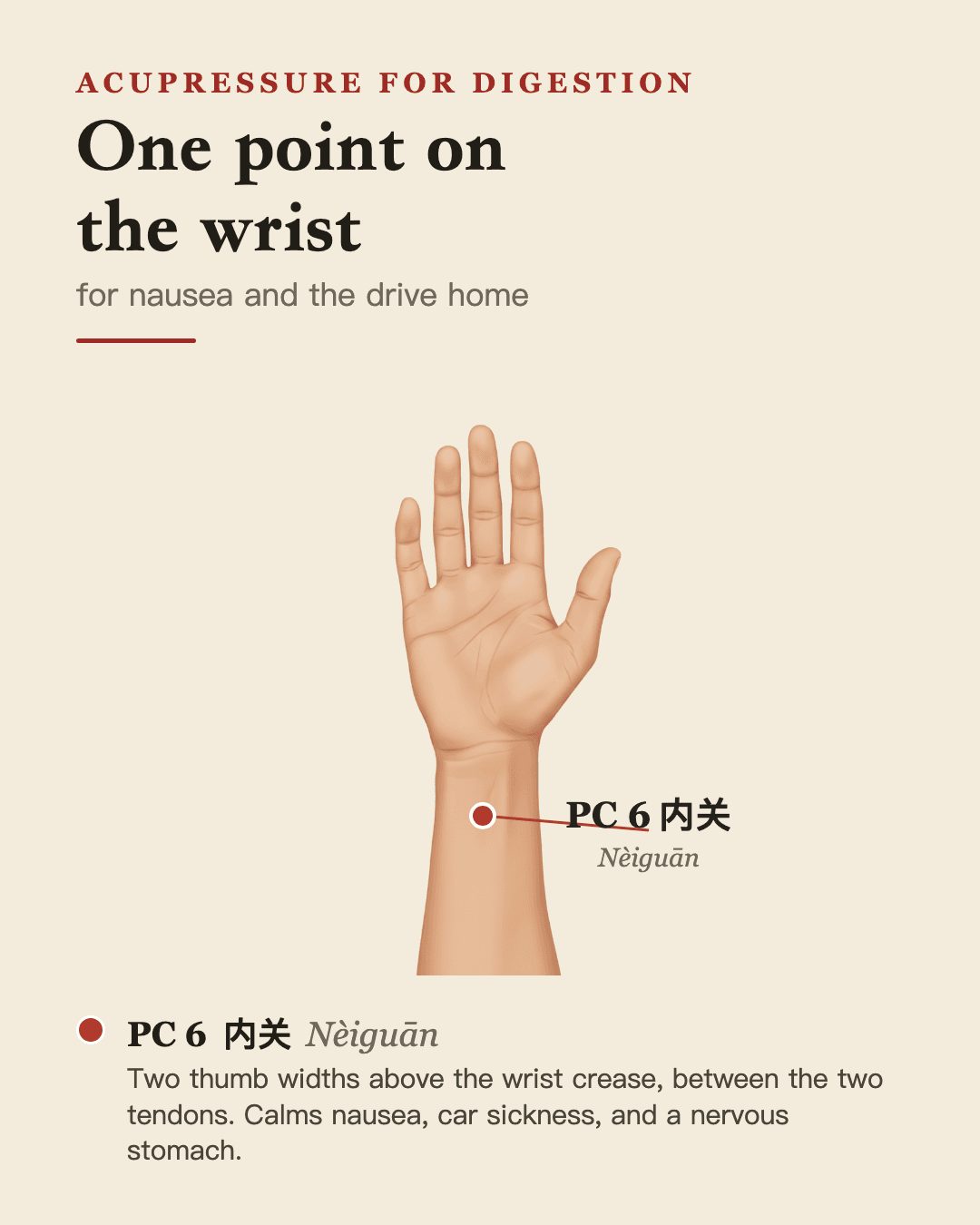
PC 6 内关 Nèiguān: above the wrist crease, between the two tendons. For nausea and the drive home.
ST 36, 足三里 Zúsānlǐ: for the heavy, wiped-out, over-full feeling
Where: four finger-widths below the bottom edge of your kneecap, then one finger-width toward the outside of the shin bone.
In the classical system this is one of the four command points, 四总穴 sì zǒng xué, the one in charge of the abdomen. Its job description: strengthen the Spleen and harmonize the Stomach, 健脾和胃 jiàn pí hé wèi. Mechanism studies, mostly in animals so far, suggest stimulating it promotes stomach emptying by way of the vagus nerve. In kitchen-crew terms, this point gets the line moving again. It's the one I'd pick if you only remember one.
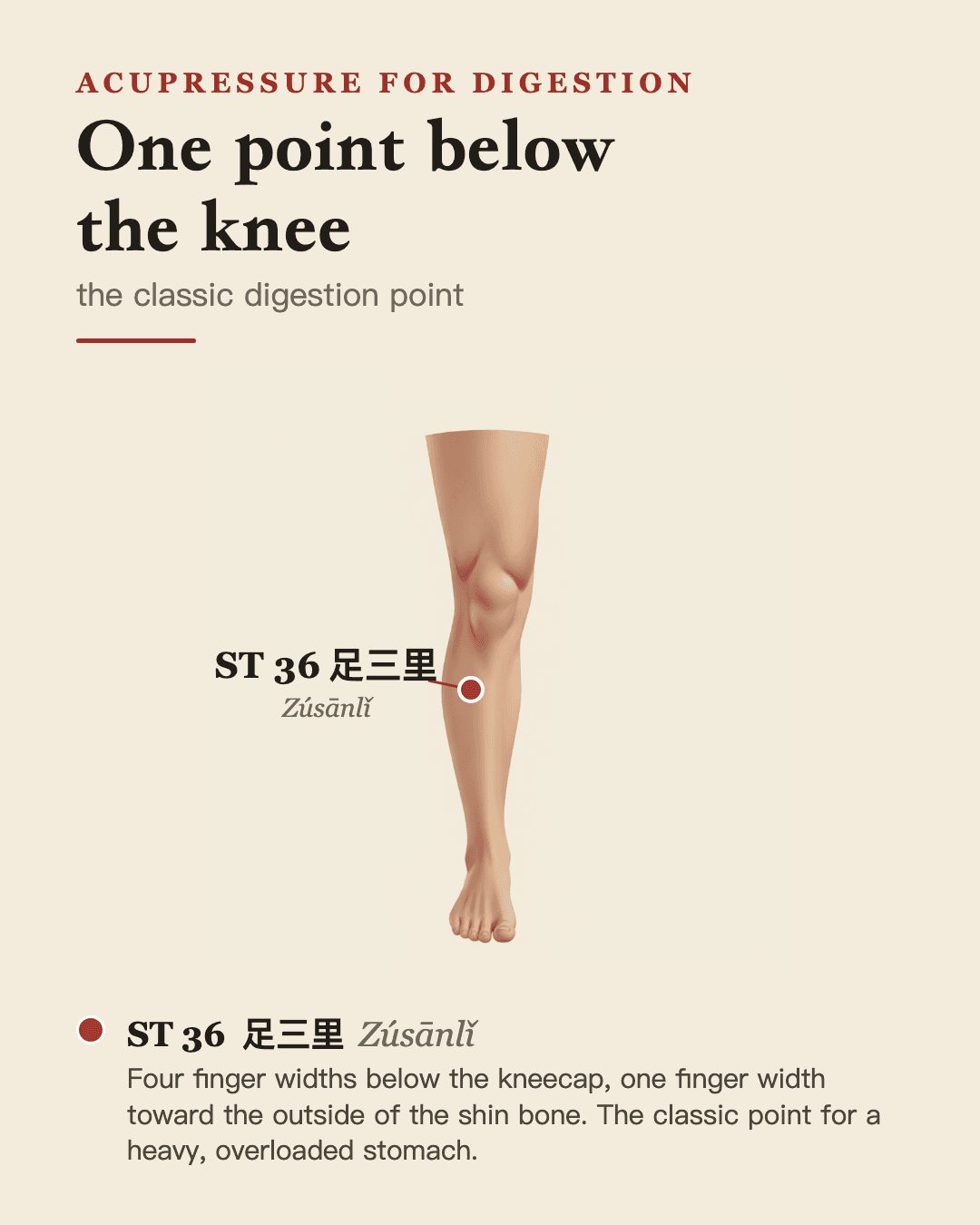
ST 36 足三里 Zúsānlǐ: four finger-widths below the kneecap, one finger-width off the shin bone. The classic digestion point.
CV 12, 中脘 Zhōngwǎn: for bloating parked at the top of your belly
Where: on the midline of your abdomen, about halfway between your belly button and the bottom of your breastbone.
This point sits directly over the stomach, and in TCM it's the Stomach's collecting point, 募穴 mù xué. Its whole purpose is to harmonize the Stomach and send what's stuck downward. For that tight, distended fullness right under the ribs, slow gentle circles work well, and so does simply resting a warm palm there for a minute. Right after a big meal, keep the pressure feather-light.
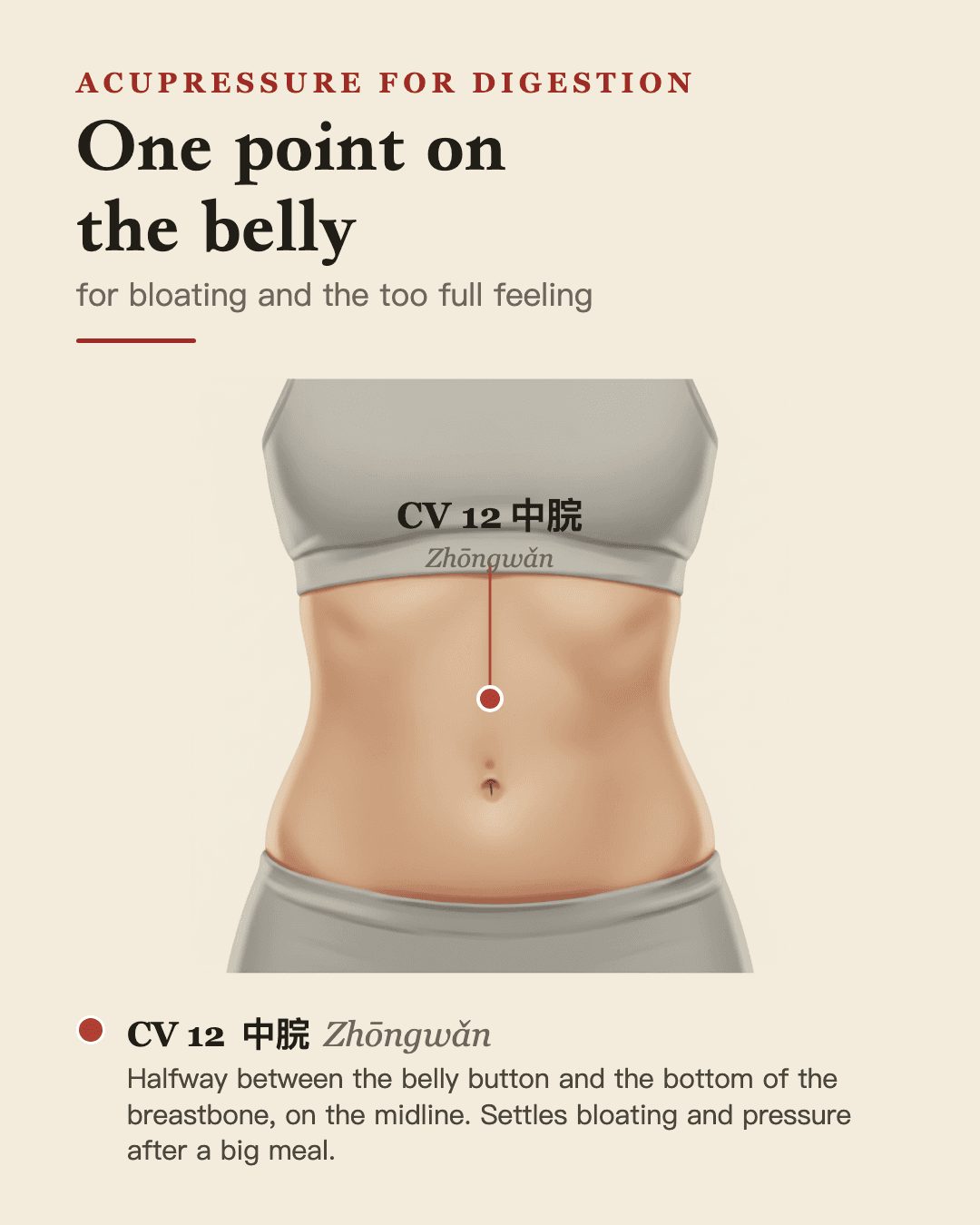
CV 12 中脘 Zhōngwǎn: halfway between the belly button and the bottom of the breastbone. For bloating and the too-full feeling.
Still heavy by Wednesday? That's a pattern
Everything above handles a weekend of overeating. It won't fix a pattern.
If the bloating, fullness, reflux, or nausea is still around days later, or shows up after normal-sized meals, or every holiday ends this exact way, that's the Spleen and Stomach asking for more than a wrist press. After 17-plus years in practice, this is the story I hear most in the week after a holiday, often from disciplined eaters: cyclists, climbers, BJJ athletes who eat carefully all season and get flattened by one weekend.
For a pattern, a course of acupuncture earns its keep. In a randomized trial of 278 people whose main complaints were exactly this cluster, fullness after meals, upper-belly bloating, and getting full too fast, four weeks of acupuncture (twelve sessions) helped about 83 percent, versus 52 percent with sham treatment. The benefit held for at least twelve weeks after treatment ended.
In clinic I usually pair needles with Chinese herbal medicine, 中药 zhōng yào, matched to your pattern. For the picture we've been describing, that often means formula families like 保和丸 Bǎo hé wán, the classic for food stagnation, or 平胃散 Píng wèi sǎn, which dries damp and settles the Stomach. Which one, or whether herbs fit at all, depends on the person in front of me. That's what an intake is for.
The walk, the warm tea, the three-hour gap, the wrist point, the needles, the herbs. One puzzle, solved from different sides.
If you're in San Francisco
If the post-feast heaviness keeps finding you, or you just want to understand what your digestion is up to, I'd love to meet you. Puzzle Acupuncture is in Bernal Heights. Book a free strategy consult and we'll confirm it's a fit before you commit to anything. No needles required for that conversation.
If podcasts pair better with your leftovers, the Puzzle Exchange podcast is where I trade notes with practitioners across Eastern and Western medicine.
And for the rest of the weekend: the fix was never eating nothing. Stop a little sooner, and give the crew a hand.