"I can focus fine at midnight. That's the problem."
A cyclist said that, before I'd asked her a thing. Up at five to train, racing on weekends, and still wired every night with her legs buzzing and the next day already looping. She came in about sleep. They almost always do.
Focus was what she wanted fixed. But it's the last thing to break, and the least of it. What I see across the table is a nervous system that forgot how to downshift and filed the whole complaint under focus.
In 2004, the average person held their attention on one screen for about two and a half minutes before switching. Now it's around 47 seconds. Gloria Mark's lab at UC Irvine has been clocking it for two decades, and the number keeps sliding.
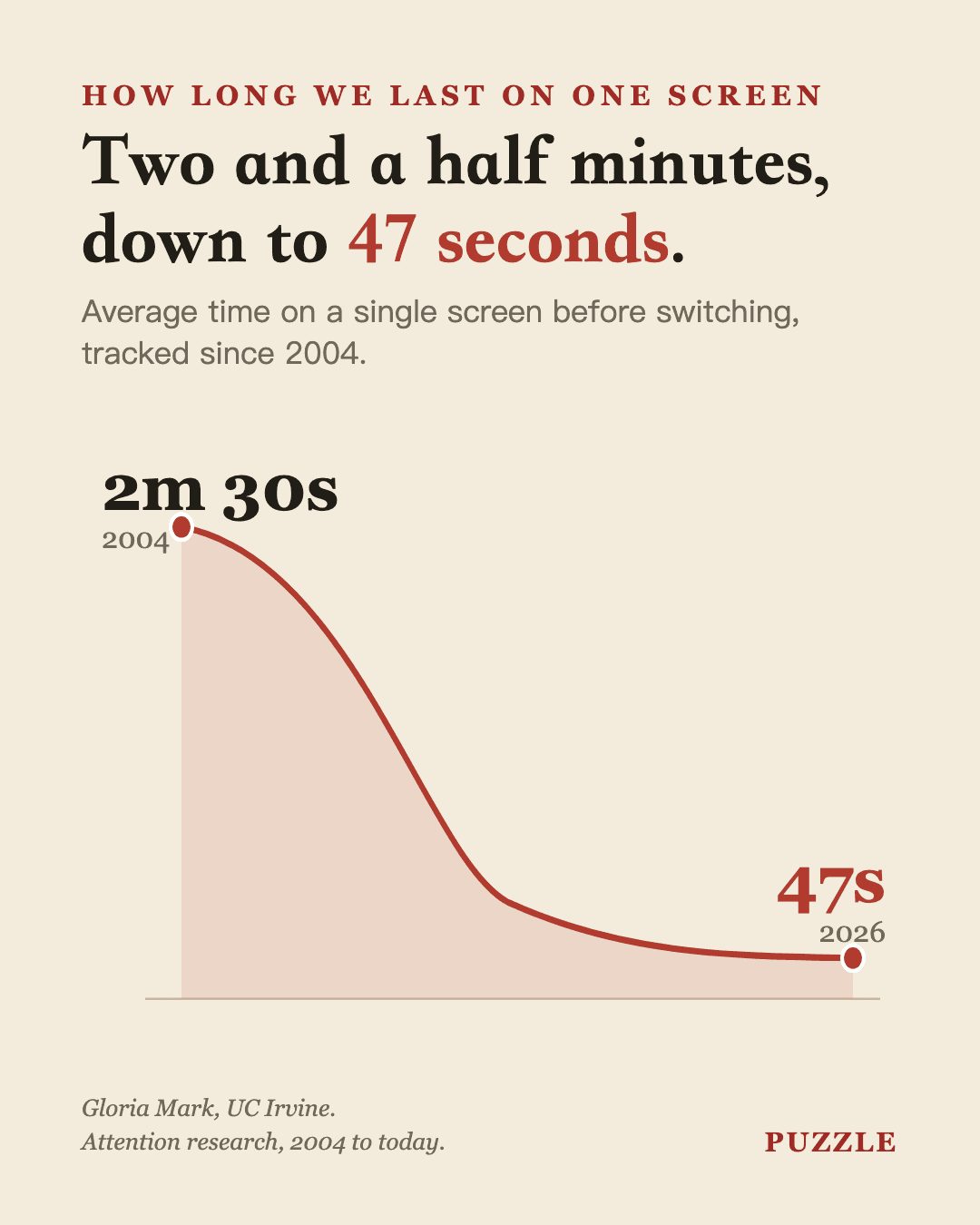
The people I see are not lazy, and they are not broken. They've spent those same twenty years drilling the exact reflex that's now grinding them down, on devices built to pull them a dozen directions at once.
And right now, in 2026, the pill itself is hard to get. The stimulant shortage started years ago and nobody has fixed it. I have patients splitting tablets to stretch a bottle, or calling six pharmacies to find their dose in stock. One called eleven times in a week and came up empty.
The shortage did one useful thing. It showed people how much of their day was riding on one small tablet.
The gas pedal and the missing brake.
Your nervous system runs on two settings. One is the accelerator. Fight or flight, the surge that carries you through a deadline or dumps adrenaline into you the second a car drifts into your lane. The other is the brake, and nobody thinks about it until it quits. Rest and digest. The setting where you fall asleep, and actually pull something out of a meal instead of swallowing it on your way to the next thing.
You're supposed to move between them all day. Up, then down.
Screens keep you up. That cyclist had been off the bike for hours, showered, in bed, and her chest was still going like the gun was about to go off. Nothing was waiting. Most of the people I see live right there now, in the fast setting, day and night. The brake didn't fail in one bad week. It got used less and less until it barely answered.
So what is a stimulant actually doing?
A stimulant raises the signal. Methylphenidate, amphetamine, whichever one you're on, it pushes more dopamine and norepinephrine into the gaps between your neurons, and with more of it sitting there you can point your attention and hold it. That part is real. I've watched the right dose hand someone their whole workday back inside a week, and I don't say that lightly.
Now look at what it leaves alone. Dopamine and norepinephrine are the chemicals that wind you up. They rev. So the drug lifts the one system already running too hot in these patients, and it goes nowhere near the one that's supposed to bring them down.
You get the focus. You keep the racing. So they grind through the whole workday and still can't switch off at night. Medicated, productive, and still wide awake at 1am with a body that won't quit.
The prescription went to the attention, because attention is what gets you in trouble at work. Whatever was keeping the person awake never got a second look.
Chinese medicine doesn't start with the word ADHD.
It doesn't begin with the diagnosis at all. It asks what state the whole system is stuck in, then it names the state.
In the old language, 阳 yang is the active side, the push to move and do and burn. 阴 yin is the quiet side, the capacity to go still, cool off, rebuild. The closest Western handle is the two branches of the autonomic nervous system, the sympathetic that revs you up and the parasympathetic that brings you down.
That handle only reaches so far, and I'm not going to pretend the map is clean. 阴 yin and 阳 yang are far bigger than two nerve branches. They cover heat and cold, the fixed structure of the body and everything moving through it. The autonomic system is just the nearest spot the idea touches ground for this one problem.
So when someone shows you a tidy chart with 阴 yin in one column and a single nerve in the other, don't trust the chart. The body never agreed to it.
Too much 阳 yang, too little 阴 yin. That's the cyclist, more or less. Buzzing on the surface, unable to land, somehow also unable to stop.
There's an old four character phrase for the shape of it: 本虚标实, empty root and busy surface. She had it written all over her.
The racing is the actual problem. That same empty root shows up as the 3pm crash you bury under a third coffee, and the digestive weirdness that lands in the same window, because your gut runs on the same depleted system and there's nothing left over to hand it.
Empty root refills. Give the body real sleep and a genuine stretch of time out of the alarm state, and 阴 yin comes back over weeks, sometimes a couple of months. Seventeen years of watching it happen, and I've stopped hedging about whether it will.
Local test booking. No email is sent.
15-minute Strategy Session
Not sure acupuncture is right for you?
Take the 1st Step Towards Solving Your Health Puzzle
What’s included
- Discuss your health concerns and goals
- Address any questions before committing to your first appointment
- We'll determine the best approach
“She's the first doctor that made me feel human and not like just another nameless number.”
GC, on Zocdoc
Next available
Loading available times…
Pacific time. No payment is taken online.
See other times
Pick a time
Times in Pacific time (San Francisco).
So I go slow. Herbs, then needles.
In the clinic this runs at two speeds.
The slow, deep work is usually Chinese herbs, 中药, taken over weeks. That's what rebuilds the depleted root, and honestly it's where most of the real change comes from. It's also the least photogenic thing I do. Nobody is going to film somebody drinking a bitter brown decoction twice a day for two months. The dramatic needle photo gets all the attention, and the herbs do most of the work.
The needles do the faster job. They reach the settling side while you're on the table, so the system gets reminded that the gear still exists. One thing I reach for a lot is 颊针 cheek acupuncture, a few fine points on the face that seem to move body and mind at once. It's one tool among several. I'll use whatever gets a given person there.
Some of it you can do at your own kitchen table.
Points you can reach without me.
These nudge the body toward the settling side, the same direction the needles push. They cost nothing, and they are on you right now.
Use the pad of your thumb. Press until you feel a dull ache, never anything sharp. Hold it, or circle slowly, for about a minute. Do both sides.
To quiet the racing, before bed. These four are the calming set. Do them with the lights already off, breathing slow, in for five and out for five.
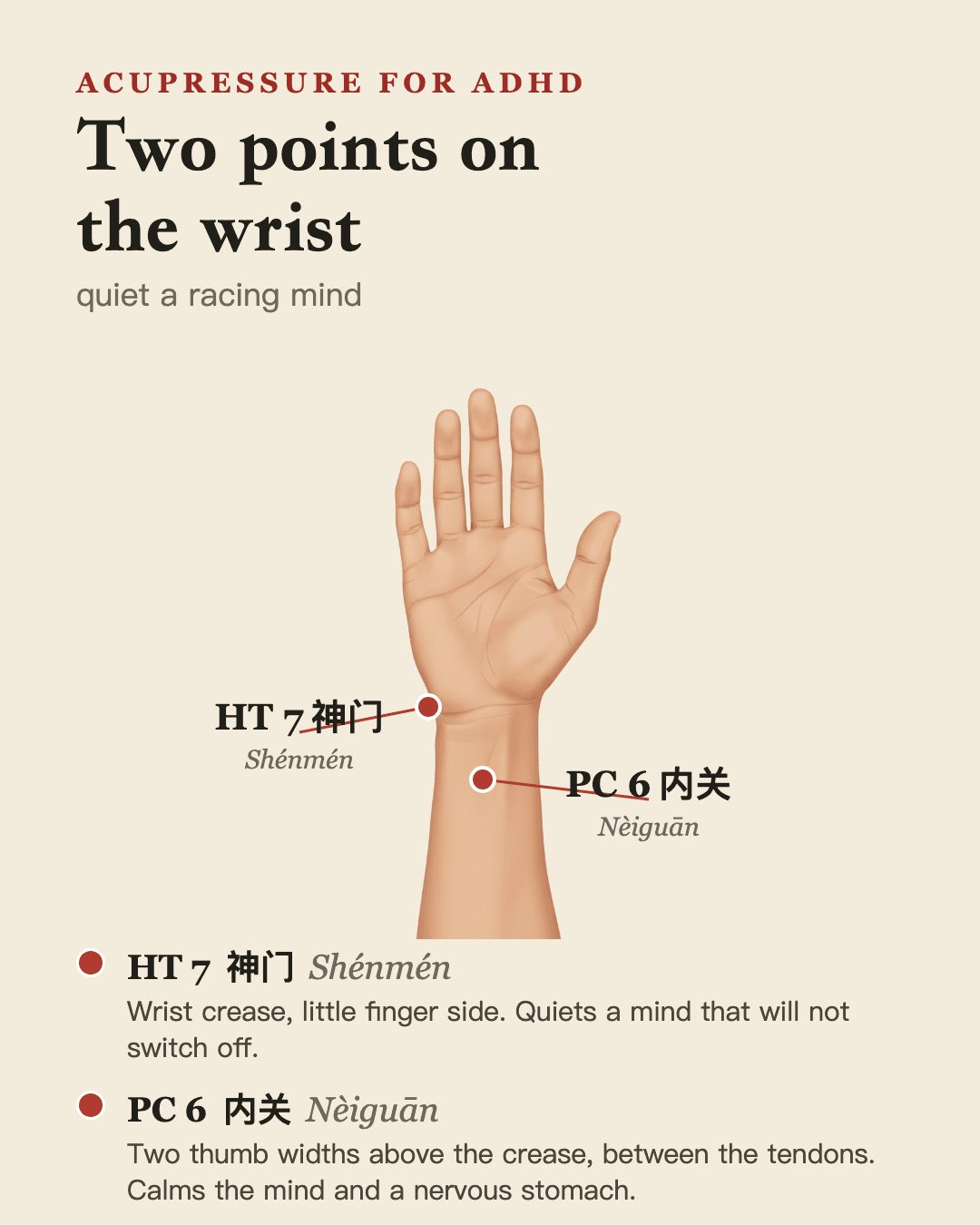
HT 7 神门 Shénmén, the "Spirit Gate." At the wrist crease on the little finger side, in the small hollow just inside the tendon. The classic point for a mind that will not switch off. The one I would keep if I could keep only one.
PC 6 内关 Nèiguān. On the inner forearm, about two thumb widths above the wrist crease, between the two tendons. It calms an overactive mind and settles a nervous stomach at once, which matters, because for a lot of people the anxiety and the churning gut are the same brake failing.
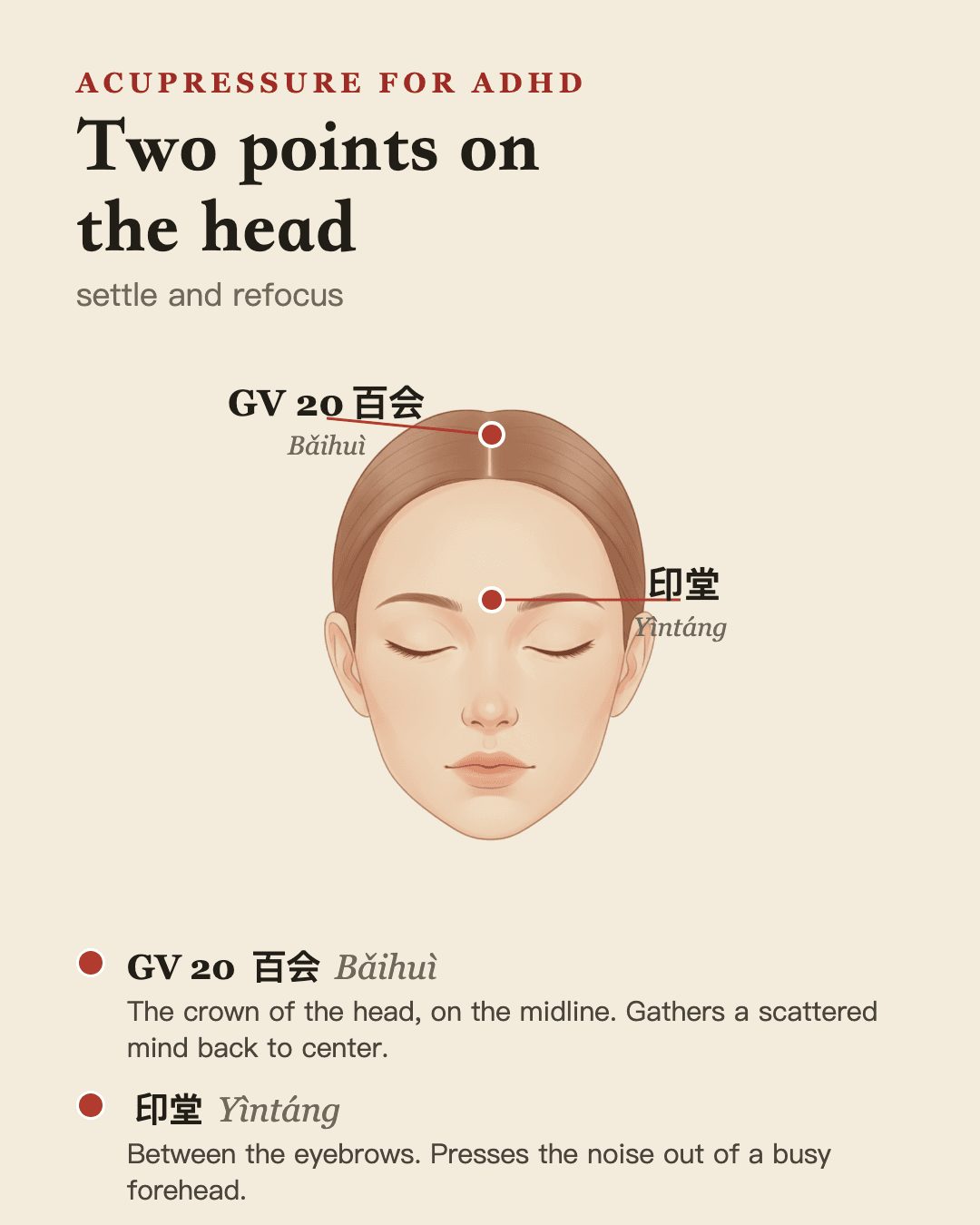
印堂 Yìntáng. Between the eyebrows, in the little dip level with the top of the nose. It presses the noise out of a busy forehead and lets stuck thoughts loosen.
GV 20 百会 Bǎihuì. At the very crown of your head, on the midline level with the tops of your ears. Press straight down. It quiets a racing head and gathers a scattered mind back toward center.
To ease off the gas, in the daytime. When the day turns you reactive and quick to snap, add one point.
- LR 3 太冲 Tàichōng. On the top of the foot, in the hollow between the first and second toes, about two finger widths back from the web. Slide up until the bones stop you. It drains the heat that makes you short with everyone, the clearest way to take a foot off the gas.
To rebuild the root, slowly. One point for the depleted root itself.
- KI 3 太溪 Tàixī. In the hollow between your inner ankle bone and the Achilles tendon behind it. This is the slow one, the point that rebuilds what all the racing has been spending. Press it gently, most nights.
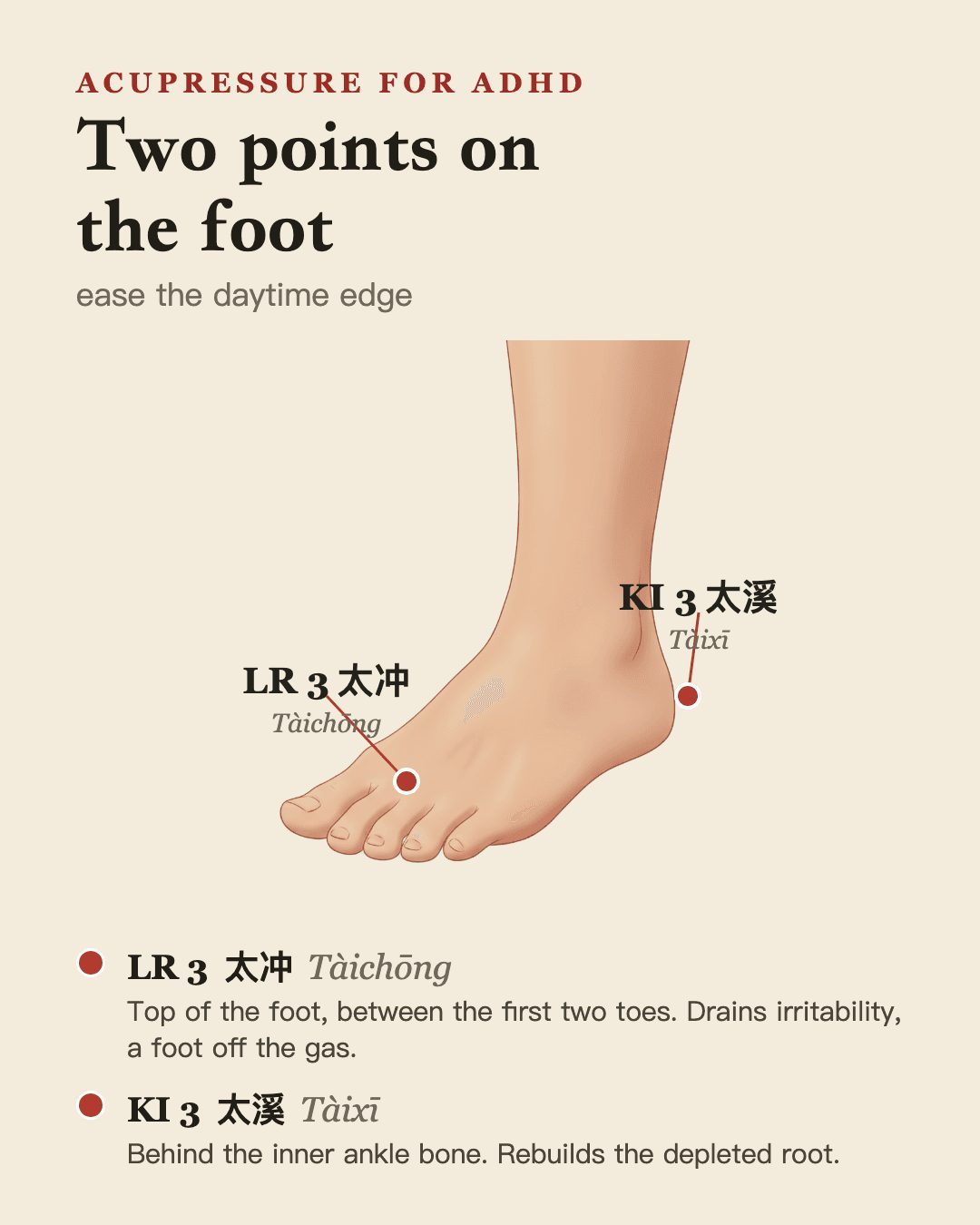
Do the calming four most nights, and reach for the other two when the day calls for it. This is roughly the edge of what your own thumbs can reach.
Acupressure is support, not treatment. No single point cures ADHD, and anyone who says one does is overselling it.
Sleep comes back first.
People always ask how long this takes. The order is more reliable than the timing.
Sleep moves first, almost every time. A week or two in, they mention it like it's nothing. Fell asleep before their head finished rerunning the day. Slept straight to the alarm for once, and woke up confused about it. The daytime edge goes next, the snapping, the low grind of irritation that nobody at home deserves.
Focus is last, and it's quiet when it finally shows up. You catch yourself an hour deep in one thing without having clawed your way there.
A climber I treat told me she got to the gym, started working one problem, and looked up to find an hour gone. The same few moves over and over, phone dead in her bag the whole time. Just her and the wall, the way it used to be before everything started pulling at her.
She told me almost like a confession. She's in every third week now.
Why sitting still is the hardest part.
The whole day is a workout for the accelerator.
Every notification trains you to switch faster. Every open tab does the same. Your phone invents errands at 11pm that could obviously wait for morning, and you get up and do them.
Almost nothing you do all day works the other side. So of course it's weak. You've never once given it a reason to get strong.
Holding one point for a slow minute is that missing practice. Forty minutes on my table with nothing to check and nobody to answer is the same practice. It feels like doing nothing. It's the only time all week that part of a person gets used at all.
So I'm never surprised when someone can't do it at first. There's a jiu-jitsu guy I've seen a handful of times who still can't get a full minute on 神门 Shénmén before his eyes snap open to check for a phone that's powered off, zipped in his gi bag in the other room. He knows exactly where it is.
Last visit he opened his eyes, looked over at me, and said, "yeah, that's not happening." He laughs about it. He hasn't made sixty seconds yet, and I've stopped telling him he's getting close.