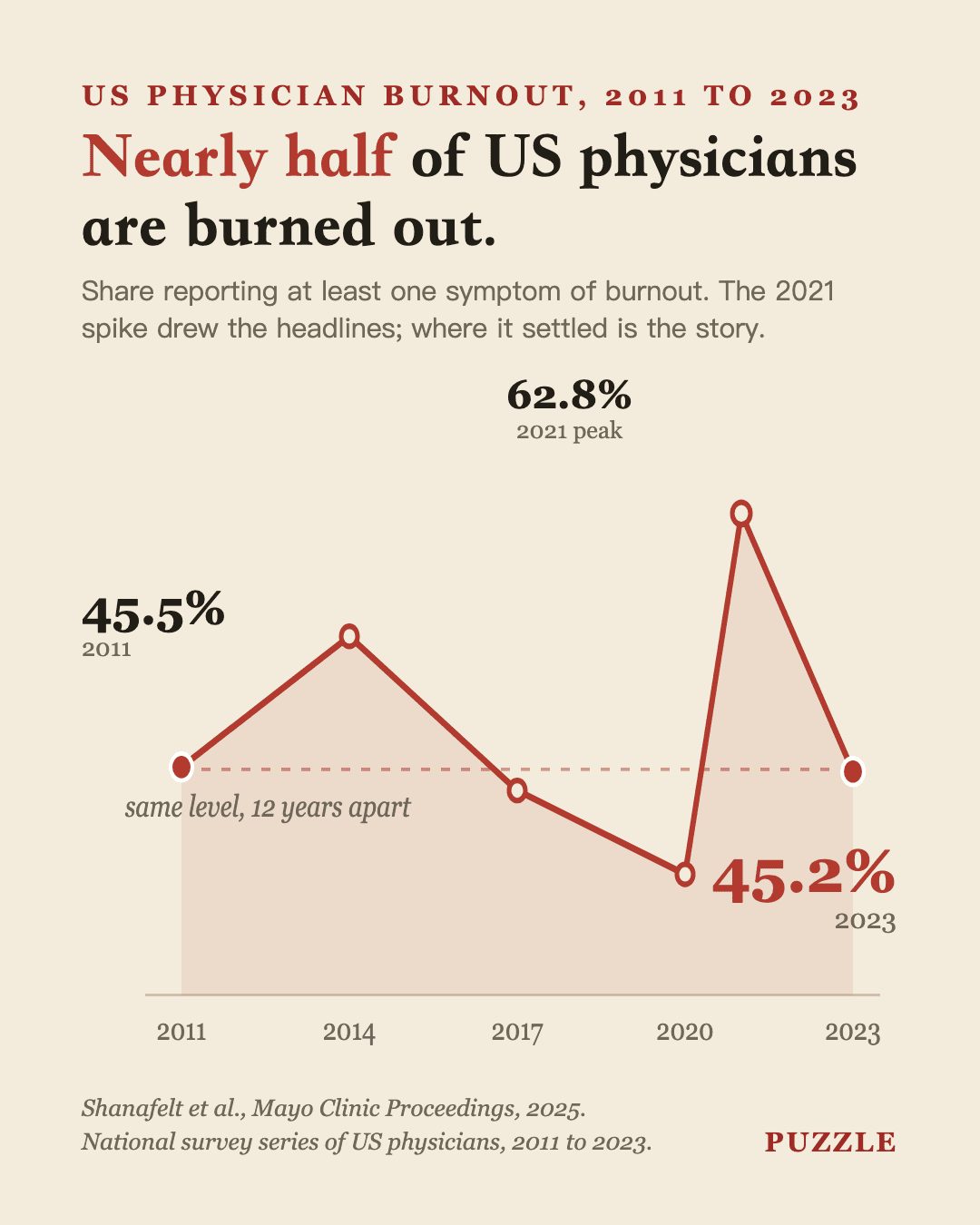
Nearly half of American physicians are burned out. The survey behind that number has measured the same way since 2011, when it read 45.5%. It spiked to 62.8% in 2021 and settled back to 45.2% by 2023. So the crisis is not worsening. It is stable, and the stable state is bad: physicians are about 82% more likely to be burned out than other American workers.
HARDBREAK2
"I actually didn't realize that I was burnt out until I left." A Psychiatrist's Own Burnout Story
Dr. Joanne Lee is a psychiatrist who spent years inside two of the largest hospital systems in San Francisco before leaving to build her own practice. Burnout is her clinical field, and she still could not see it in herself. She said so on our podcast, Puzzle Exchange, more openly than anyone in her position has to.
"I actually didn't realize that I was burnt out until I left. I didn't even realize, because I was too busy going through the day to day." She was giving her best to her patients, to her colleagues, and to a standard she had set for herself. She did not leave because she knew she was burned out. She left, and then looked back.
There is no grievance in her account. She calls the benefits golden handcuffs and means it warmly. She had both her babies at Kaiser, nearly lost the first to a knot in his umbilical cord, and was cared for well enough that she says "I was so proud to be a physician at Kaiser." She loved the work and burned out inside it.
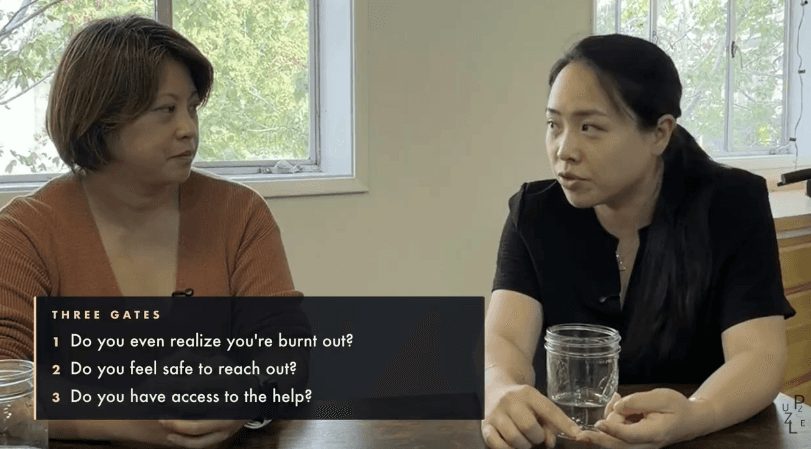
She sorts the problem into three gates. Do you realize you are burnt out. Do you feel safe reaching for help. If you reach, is help there. Most of the conversation about physician wellness addresses the third. Hers stopped at the first, and she will not pretend the second is solved: "These concerns are still valid. I cannot promise them it's not going to affect them."
HARDBREAK2
Her signal is not discomfort, because "every time we learn something new, it's uncomfortable." It is hopelessness: the sense that the thing making you sick is not something you are allowed to change. On leaving she has two conditions. Not during a depressive or anxiety episode, when the certainty you feel is a symptom talking, and not without a next step.
Before she left, she could not give her patients more time, so she moved her administrative block against her intake slot and let one bleed into the other. Sixty minutes became ninety. She could not change the hospital. She changed where one block sat on her calendar.
She is also the reason we ran Build Without Burnout, our reset night for founders and creators, in January.
Burnout Is Not a Coping Failure. It Is the Job.
A 2026 national study measured moral distress, being made to deliver care you believe is wrong for the patient in front of you. 39.1% of US physicians reported it at a high level, against 14.2% of workers in other fields. Among those with low moral distress, 30.7% had a burnout symptom; among those with high, 75.1% did.
The mechanism is not mysterious. In a time-and-motion study, every hour of face-to-face patient time came with nearly two more hours on the electronic record. And at the start of 2026, 82% of US physicians worked for a hospital or a corporate entity. More paperwork than patients, and less say over either.
The Silence Is Rational, Because the Paperwork Made It Rational
Licensing and credentialing applications have long asked whether a physician has ever been diagnosed with or treated for a mental health condition. Not currently impaired. Ever. A yes could open an audit.
A 2017 study of 5,829 physicians found nearly 40% would be reluctant to seek care because of what it might do to their license, and in states that asked those questions they were 21% more likely to say so. This is changing. Washington dropped the past-history language in 2023, and the Dr. Lorna Breen Heroes' Foundation has now cleared 44 licensure boards and more than 1,400 hospitals. It is not finished: in 2025, 38% of physicians still said they, or a colleague, had been afraid to seek care because of these questions.
Local test booking. No email is sent.

15-minute Strategy Session
Not sure acupuncture is right for you?
What’s included
- Discuss your health concerns and goals
- Address any questions before committing to your first appointment
- We'll determine the best approach
“She's the first doctor that made me feel human and not like just another nameless number.”
GC, on Zocdoc
Next available
Loading available times…
Pacific time. No payment is taken online.
See other times
Pick a time
Times in Pacific time (San Francisco).
Chinese Medicine Split Burnout in Two Long Before Anyone Measured It
Chinese medicine files it under 郁证, stagnation, and the useful part is not the name. It is that the tradition sorts burnout into two states that need opposite treatment.
The first is pressure that will not move. The Liver, in this system, governs the free flow of qi, and emotion moves with it, so long pressure stops the flow. The classical image is a tree whose branches have been tied so they cannot spread: tight chest, aching ribs, a jaw that will not unclench, a temper that runs short and then goes flat. You would call it wired and unable to stop.
The second is what is left after years of the first. The Spleen here is not the organ your surgeon knows. It is the function that turns food into usable energy, and it also governs thought, which is why worry exhausts it. When it fails, the body stops making the blood that feeds the Heart, and the Heart is where the spirit is housed. That reads as fatigue, no appetite, fog, broken sleep, a mood gone flat.
HARDBREAK2
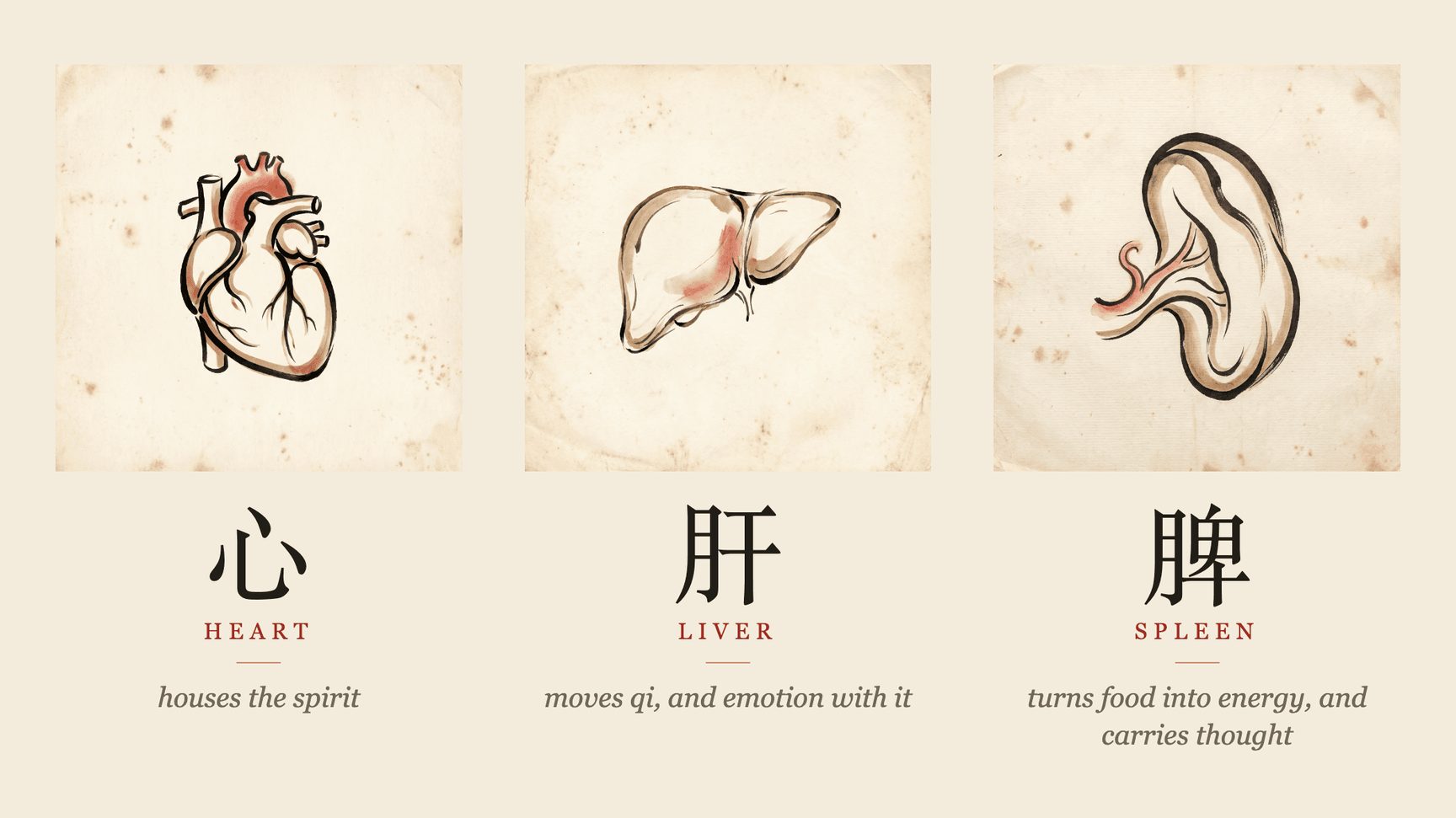
Read those organ names as job titles rather than anatomy and the system becomes legible. The claim underneath them is one Western medicine now makes in its own vocabulary: what you feel is not filed separately from the body carrying it.
The consequence is practical. Stage one is a system that will not downshift. Stage two is a system with nothing left to downshift with. Give a depleted person the treatment for a wound-up one and they get worse. It is why a week of vacation resets some people and does nothing at all for others.
These Four Points Are Practice, Not Treatment
These are the four I gave Joanne when she asked which points reach the vagus nerve. None treats burnout. They rehearse the downshift, so the body remembers it is available.
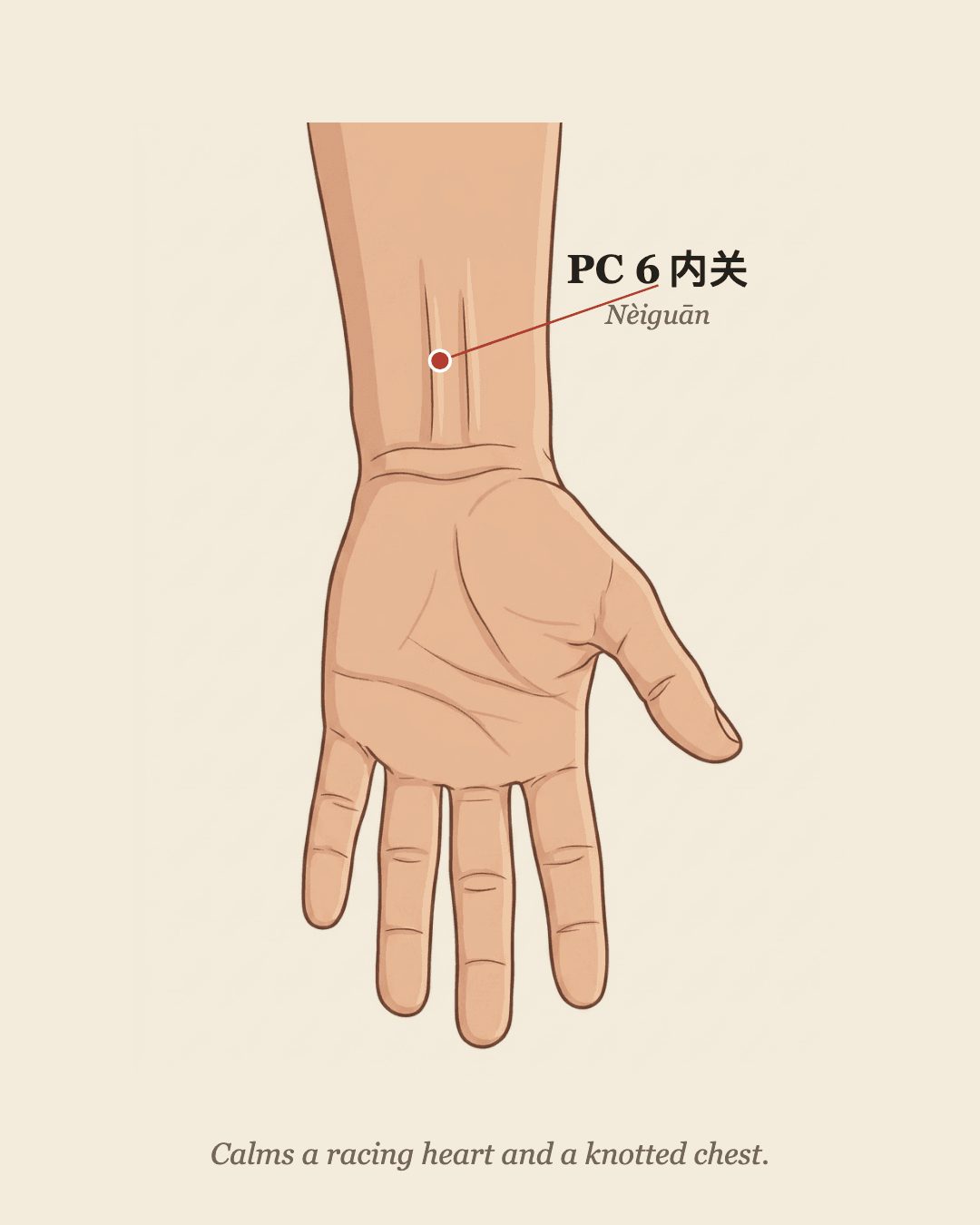
PC6 内关 Neiguan
Palm-side forearm, three finger widths above the wrist crease, between the two tendons. The point a travel-sickness wristband presses, and where I go for palpitations and a tight chest.
HARDBREAK2
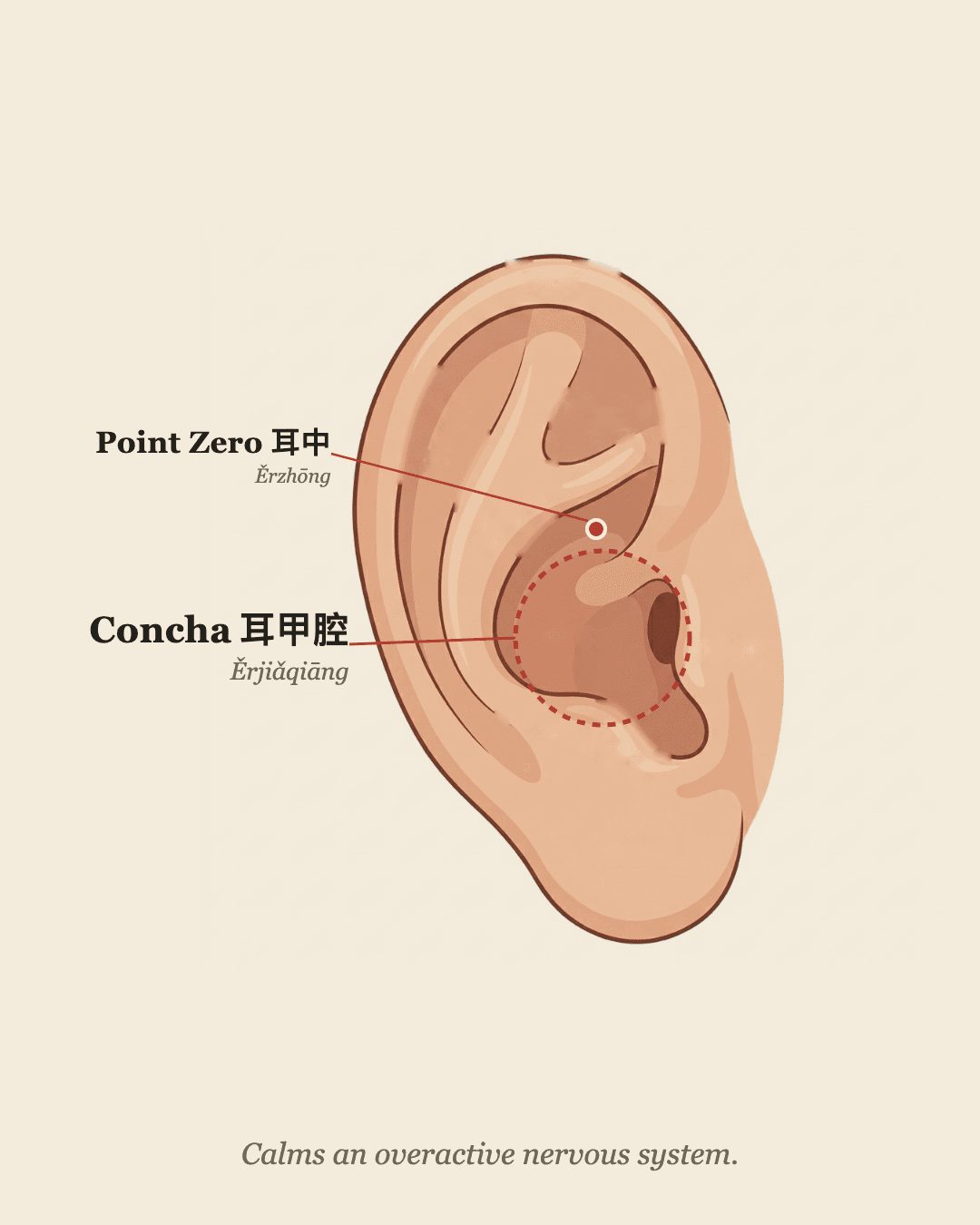
The ear
The concha, the hollow bowl around your ear canal, is the only skin the vagus nerve reaches. Follow the ridge of your ear down to where it meets that bowl, and press gently, do not dig.
HARDBREAK2
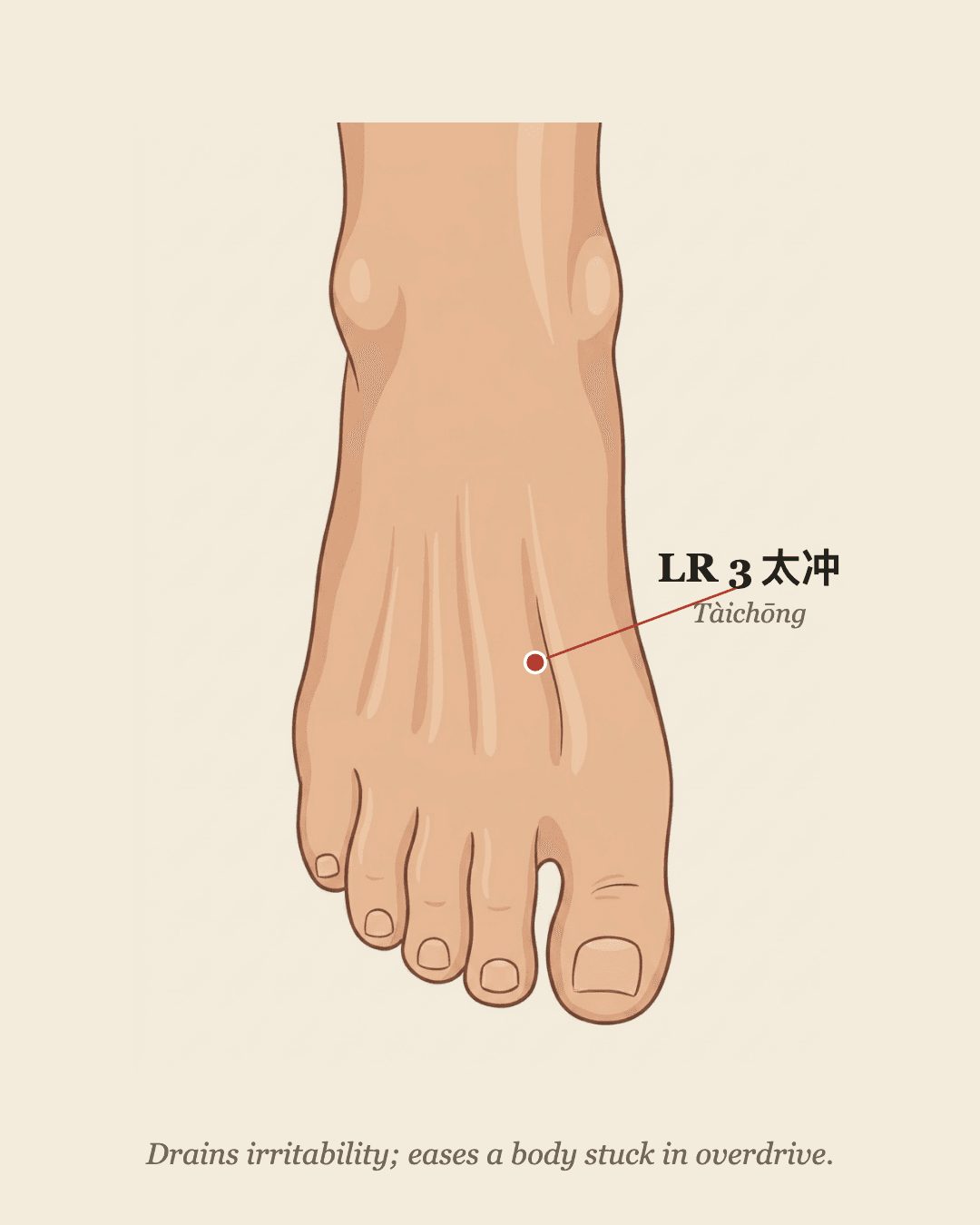
LR3 太冲 Taichong
On top of the foot, slide up from the web between your big toe and second toe until your finger stops in the dip. The stagnation point, for the jaw-clenched stage.
HARDBREAK2
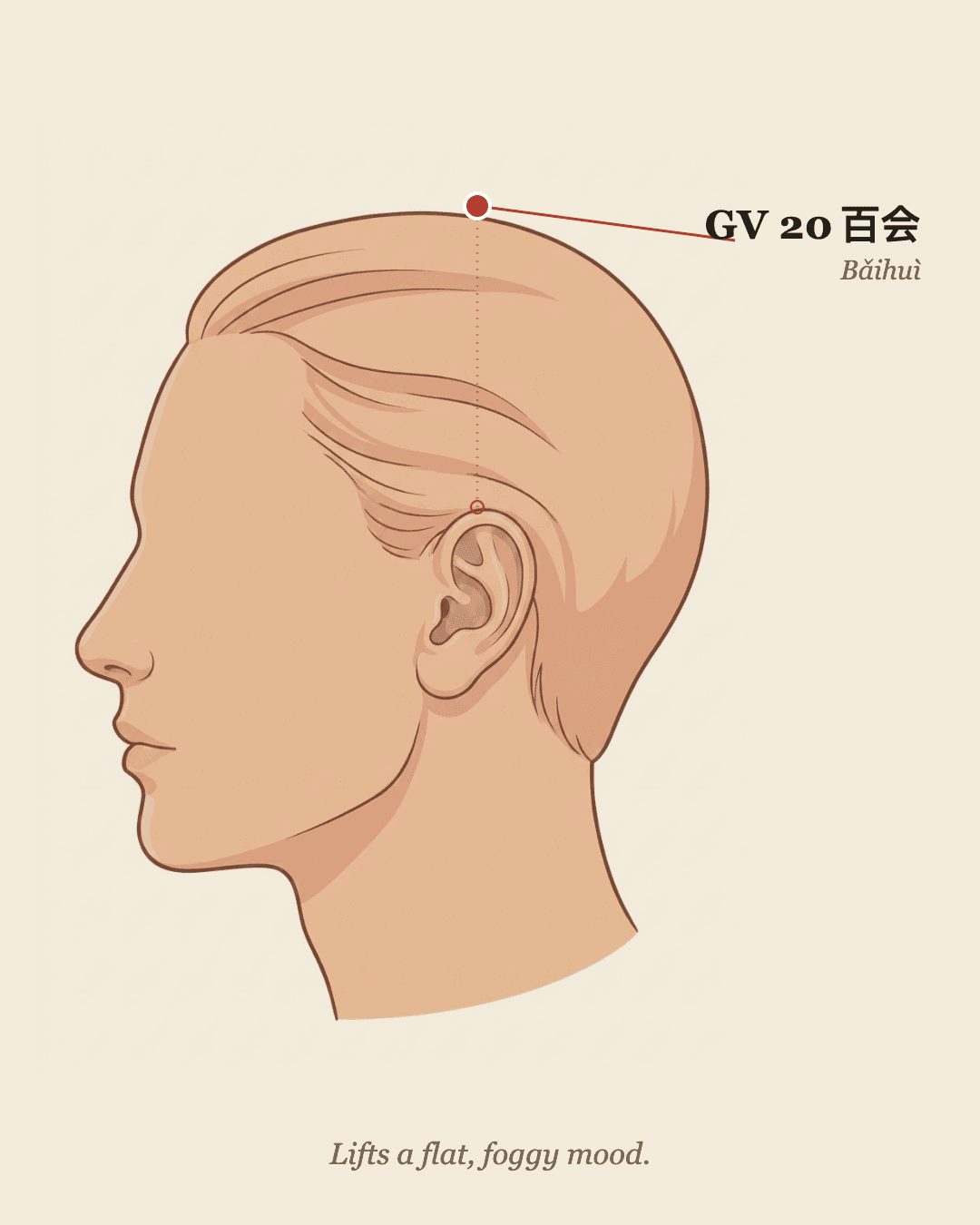
GV20 百会 Baihui
Top of the head, on the midline, level with the tips of your ears. Tap it rather than press it.
HARDBREAK2
Sixty to ninety seconds each, firm enough for a dull heaviness, never sharp pain, breathing out longer than you breathe in. Self-acupressure is the gentle cousin of clinical acupuncture, not a substitute for it, and not a substitute for care if you are in a dark place.
The Hard Part Is Not Treating Burnout. It Is Naming It in Time.
Nearly half of American physicians are burned out, and that share has held for more than a decade. This is not a resilience problem. The job is built to produce it, and the paperwork around it makes silence the rational response, so the people best placed to describe the condition are the ones least free to admit they have it.
That leaves recognition as the bottleneck. A psychiatrist whose clinical field is burnout could not see her own until she had already left, which is worth sitting with before assuming you would catch yours.
And burnout is not one condition. It is two opposite ones sharing a word: the system that will not slow down, and the system with nothing left to slow down with. Which of the two you are in decides whether rest repairs anything, and it is the question almost nobody asks.
Discomfort is not the line. Hopelessness is, and what crosses back over it is usually smaller than leaving.