Children are treated differently from adults, and with small children needles are a small part of it. What I use is decided by your child's age and by what the examination finds.
Trained and practised in BeijingFewer needlesModern acupuncture
Dr Deb Ma, PhD, LAc, OMD · 1640 Valencia St, San Francisco
17 years, most of them in BeijingPhD from Beijing University of Chinese Medicine, then clinical practice at Beijing United Family Hospital.
Integrated practiceTen of those years working across departments with neurologists, OB/GYNs and psychologists on the same patients.
Fewer needlesPoint selection is deliberate and minimal. Most patients are surprised how little is used.
Most kids come in for digestion, breathing, skin, sleep or mood
About a fifth of my Beijing caseload was children, often referred by pediatricians. Here I start with what is troubling your child, what their pediatrician has found and which symptoms we can reasonably address together.
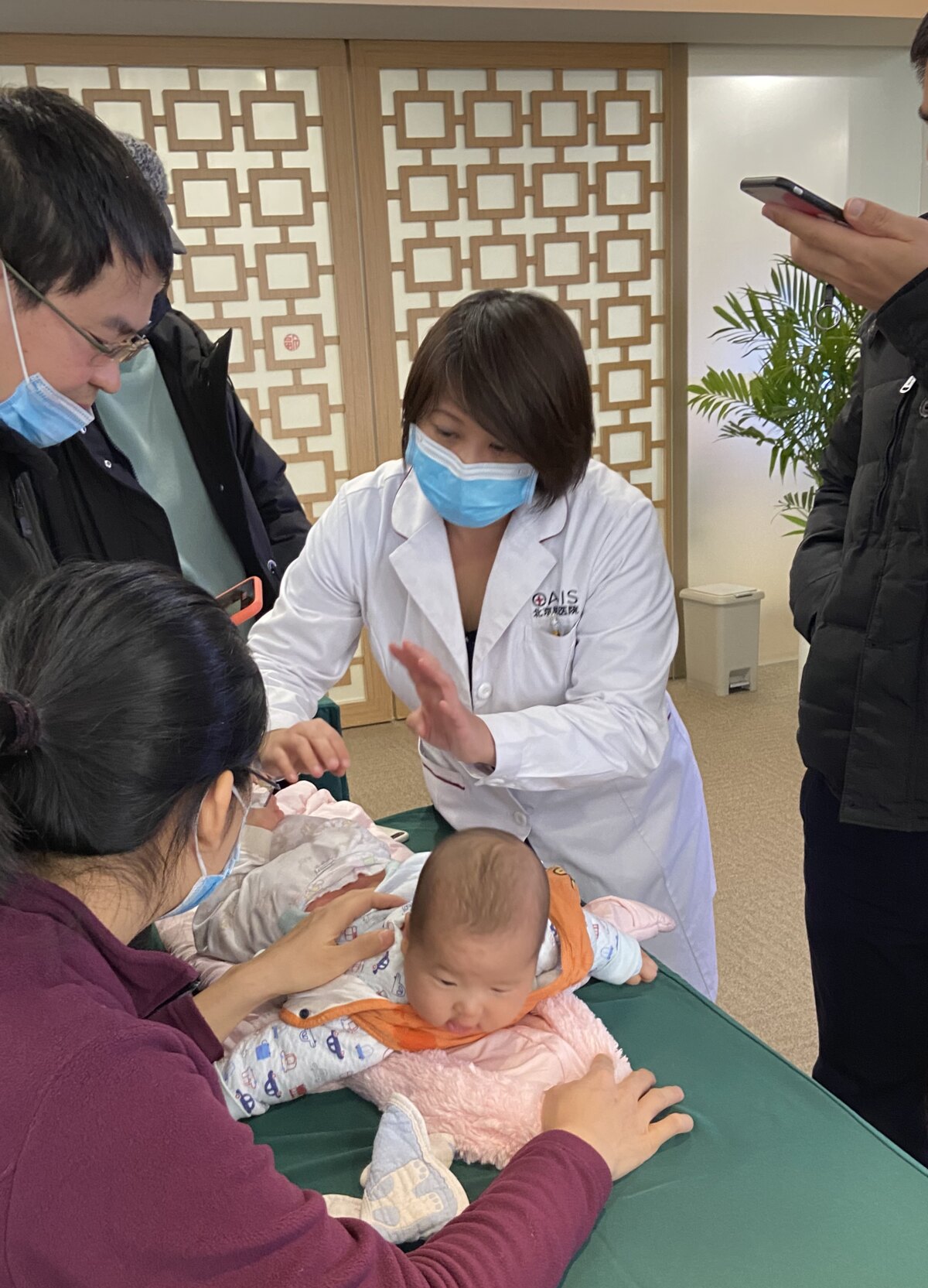
Dr Deb during her pediatric work at the best international OB/GYN hospital in Beijing, Beijing United Family Hospital. At Puzzle in San Francisco, she sees children from six months old.
Digestive concerns include poor appetite, constipation, loose stools and recurrent stomach aches. Feeding difficulties or poor weight gain also need your pediatrician's assessment.
For children with allergic rhinitis or a lingering cough, we discuss symptoms alongside their existing medical care. Acupuncture does not replace asthma treatment.
Skin concerns include eczema and, in teenagers, acne. Bring the treatment plan you already use.
Sleep concerns range from frequent waking to a teenager having trouble falling asleep. I ask about the routine at home and other symptoms.
Parents also bring children with tics, restlessness or muscle tension. With ADHD, we can discuss associated sleep or appetite concerns; acupuncture is not an established treatment for attention problems.
I see children from six months old. Under a year, care uses hands-on techniques and, when appropriate, herbs. I do not use needles or ear seeds at that age.
Chinese guidelines discuss indigestion (2024), tics (2024) and allergic rhinitis (2023), but the evidence varies by condition and technique. The tic guidance also allows monitoring without treatment when tics do not interfere with school, play or friendships.
For small children, hands-on care usually comes before needles
Pediatric tuina is a system of massage strokes and points adapted for children. I choose the technique and length of the visit around your child's age, symptoms and comfort.
Chinese medicine reads a child as a body still being built
The traditional framework pays particular attention to digestion, breathing and growth. Its terms spleen, lung and kidney describe Chinese-medicine functions, not a diagnosis that those organs are weak or diseased.
Tuina uses small, repeated movements on the hands, forearms and body
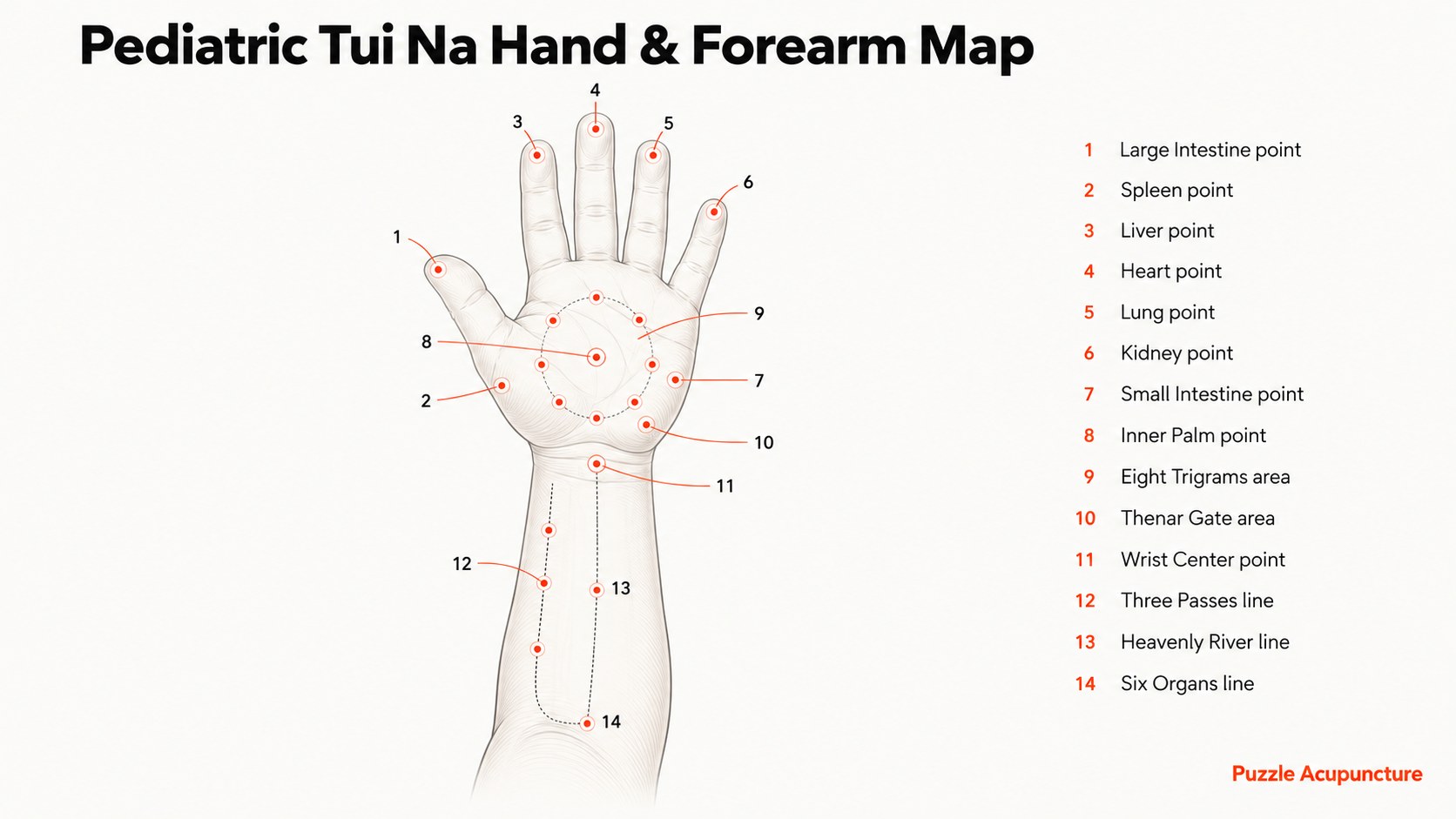
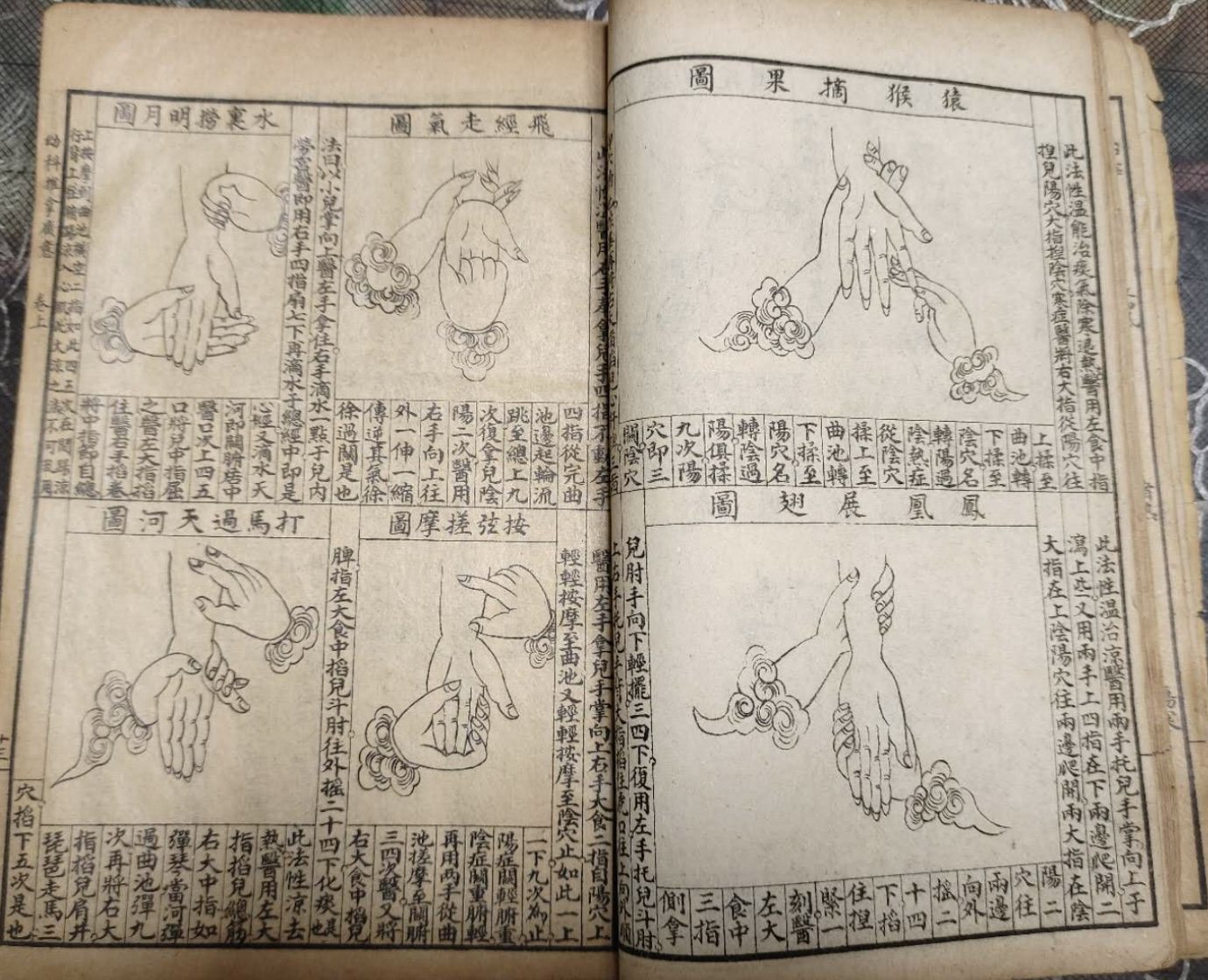
The hand and forearm map includes the Thenar Gate below the thumb, the Eight Trigrams area on the palm, and the Three Passes, Heavenly River and Six Organs lines on the forearm. These are traditional treatment maps; they are not anatomical connections to the named organs. The illustrations show the areas I may work on.
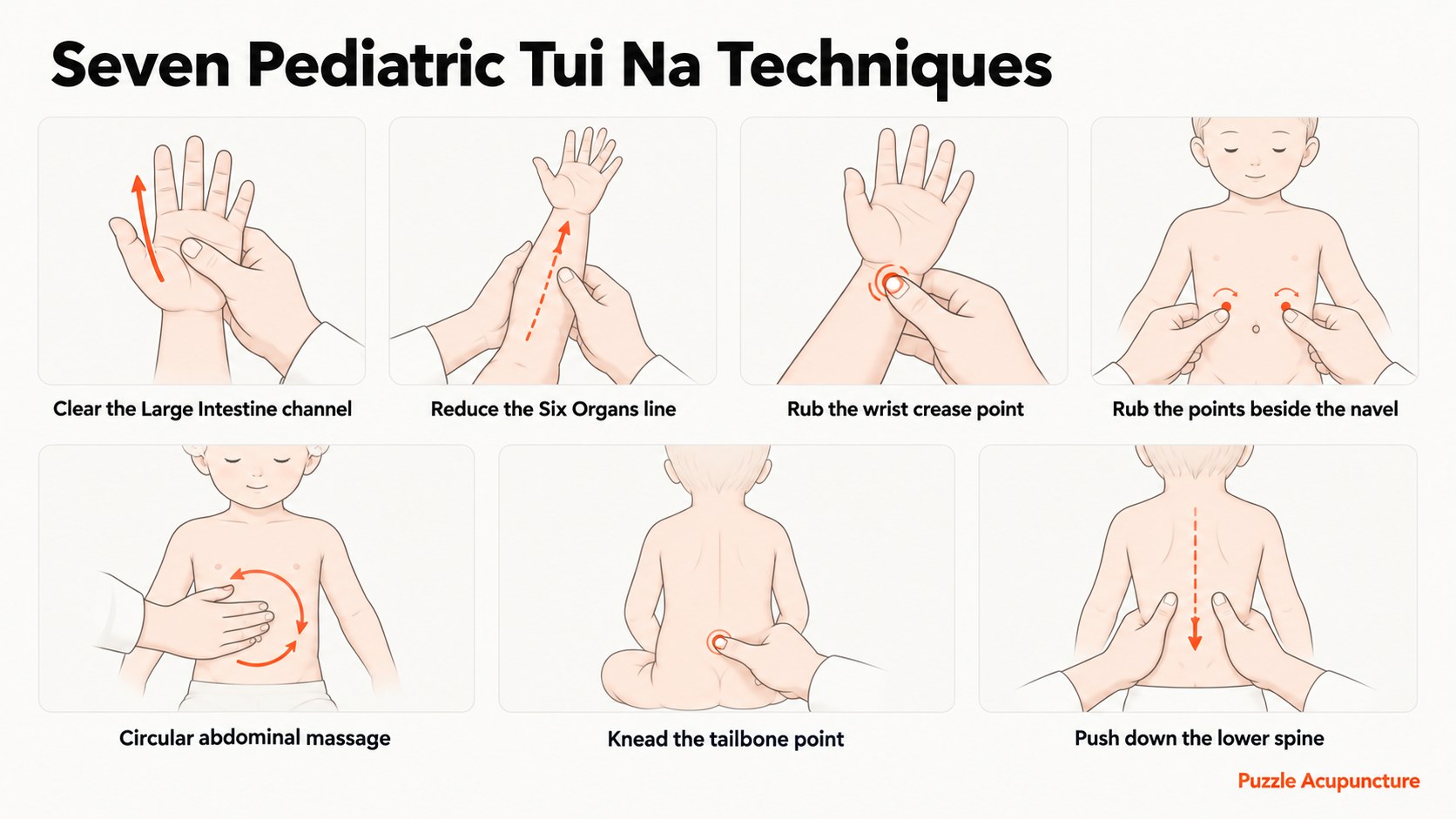
The strokes include pushing, kneading, pressing and rubbing. Direction and pressure are part of the technique, so I demonstrate any home routine and watch you practise it. Historical stroke counts are not a dose to follow from a webpage.
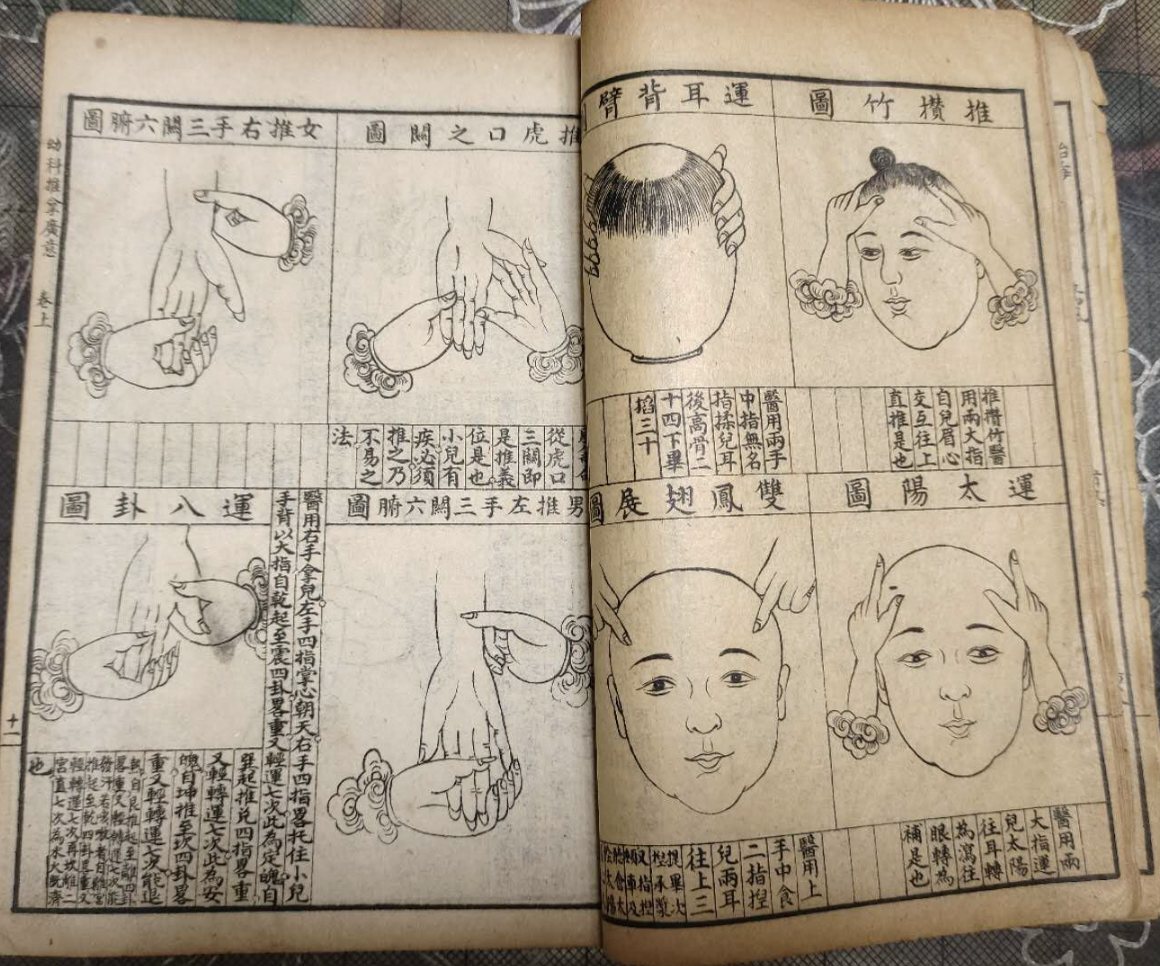
The plates below come from Xiong Yingxiong's pediatric tuina manual, compiled around 1676, in an edition printed by lithograph between 1912 and 1949. They show how the hand movements were recorded and taught.
A Republican-era lithograph-printed medical book on pediatric tuina.
The first spread shows face and forearm techniques; the second records sequences with names such as “the phoenix spreading its wings”. These pages document the practice's history. At a visit, I also rely on what you have observed at home and what your child can tell or show me.
The 2024 Chinese guideline on indigestion recommends tuina for some children with poor appetite, while rating the evidence low. The 2021 diarrhoea guideline gives a weak recommendation for adding tuina to conventional care, including rehydration. A guideline recommendation does not mean the treatment has equally strong evidence for every symptom.
Tuina is used with infants as well as older children. At Puzzle, the starting age is six months; ear seeds may be considered after the first birthday. Needling depends on age and whether the child is comfortable with it.
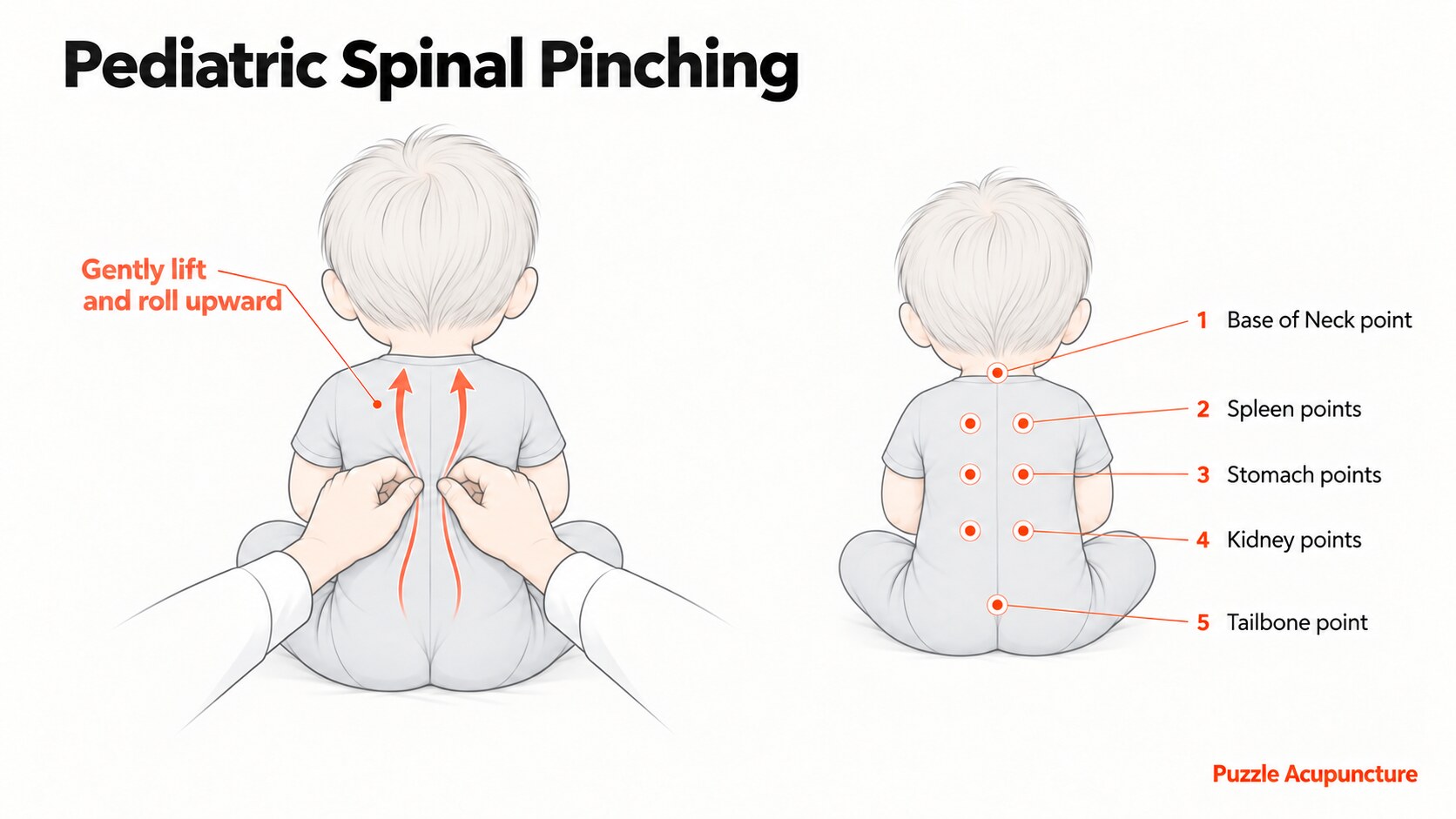
Spinal pinching works the skin along the back
The child lies on their front or across a parent's lap while I lift and roll the skin along the back. This is work on the skin, not an adjustment of the spine. I explain it first and stop if your child is uncomfortable.
A version appears in Ge Hong's fourth-century handbook, and spinal pinching is included in the 2024 Chinese guideline's tuina routine for poor appetite. Its long history is separate from the modern evidence.
If it is appropriate for your child, I can teach you a short version to use at home. The pressure and routine should be demonstrated in person.
Ear seeds are small seeds held over points on the ear with adhesive. I consider them after the first birthday and show the parent how to use and remove them. The 2023 Chinese rhinitis guideline includes them but rates the evidence low.
Herbs are considered individually, with the child's age, weight, symptoms and medication in mind. They may be prescribed as granules or an external preparation. A study of one formula does not establish that all herbal products work the same way or are suitable for every child.
Grades, ages and protocols are from the Chinese guidelines on allergic rhinitis in children (2023), treating tics from the outside (2024), indigestion in children (2024) and tuina for acute diarrhoea (2021), and from the national technical standard for pediatric tuina (2021). The history is from the texts themselves: Ge Hong's Handbook of Prescriptions for Emergencies, volume one; Xiong Yingxiong's Youke Tuina Guangyi, volume one, pages eleven and thirteen. Grades are the guidelines' own: A is the strongest evidence, E the weakest.
Modern acupuncture
Small trials suggest benefits when hands-on care is added to usual treatment
In a 2025 trial at one Shijiazhuang hospital, 200 children with poor appetite received usual care alone or with tuina and a herbal formula added. At four weeks, the treating doctors rated 47 of 100 children in the combined group “cured”, compared with 32 of 100 in the usual-care group. The study tested the combination, so it cannot tell us how much benefit came from tuina alone.
Children with poor appetite rated cured or improved after four weeks
Share of each group, 100 children per group. Axis starts at 20 percent
Tuina and herbs addedStandard care alone
Qiao Xiaoyang and colleagues, 2025. 200 children with the trial's cold, weak-digestion pattern. Outcomes were rated by treating doctors, who knew the treatment. Adverse events occurred in 5% of the combined group and 7% of the control group, without a statistically clear difference.
A 2024 Jiangxi trial studied 120 children aged 3 to 14 with allergic rhinitis. All received basic care, with ear seeds, herbal nasal drops or both added for eight weeks. The doctors rated 39 of 40 improved with both additions, 32 with drops and 31 with seeds. There was no basic-care-only group.
Children with allergic rhinitis rated improved after eight weeks, by treatment
Share of each group, 40 children per group, ages 3 to 14. Axis starts at 60 percent
Zhong Yemin and colleagues, Guangming Journal of Chinese Medicine 2024;39(9):1771-1774. One hospital, 40 children per group. All groups received basic care, including cetirizine for moderate to severe cases. The authors reported no adverse reactions; a small study cannot establish that a treatment has no risks.
A separate 2026 review of 24 trials studied press needles, which are not the same as ear seeds. It found benefits when press needles were added to medication for allergic rhinitis; press needles alone were not clearly better than medication.
These studies involve specific ages, diagnoses and treatment combinations. They do not establish that the same approach will help every child. At a visit, we agree on a symptom to track and reassess whether adding treatment is useful.
Frequently Asked Questions
Does it hurt?
For babies, I use hands-on techniques rather than needles. Older children may be offered ear seeds or needling when appropriate. Any technique can feel uncomfortable, so I explain it first, check how your child is responding and stop if they are not comfortable.
How young can a child be?
Six months. Under a year, I use tuina and may consider herbs; I do not use ear seeds or needles. From the first birthday, ear seeds may be an option. Regular needling is considered from about three, only when appropriate and when the child is comfortable with it.
What if my child will not sit still?
Then we do not use needles that day. We can try a shorter hands-on visit, take breaks or stop. Your child can stay close to you, and we work at a pace they can tolerate.
Can I learn the tuina and do it at home?
Yes, when it is appropriate for your child. I demonstrate two or three strokes, watch you practise and write down the routine, including pressure and direction. We also discuss when to stop and when symptoms need your pediatrician.
Do I keep giving the medication?
Yes, unless the person who prescribed it says otherwise. Bring a list of medication and supplements. If reducing a medication is the goal, your pediatrician decides whether and how to do that; I can share what I am seeing with them.
How many needles?
Many visits for younger children use no needles. When needling is appropriate, I use a small number and explain the points to you and your child first. The number and time depend on age, symptoms and comfort.
What does it cost?
The first consult is free. A new patient visit is $255 for 75 minutes and follow-ups are $205 for 60 minutes. Current rates are on the pricing page.
Tell me how old your child is
The consult is free. We go through what is happening, what the pediatrician has said, and whether Chinese medicine is a reasonable thing to add. If it isn't, I will tell you.