Digestion & Gut

Acupuncture for IBS, Bloating & Digestion in San Francisco

Bloating after meals, IBS and constipation need different treatment plans. I start with your symptoms and any diagnosis you already have, then discuss where acupuncture may help and what we would track.

Trained and practised in Beijing Fewer needles Modern acupuncture

Dr Deb Ma, PhD, LAc, OMD  ·  1640 Valencia St, San Francisco

17 years, most of them in BeijingPhD from Beijing University of Chinese Medicine, then clinical practice at Beijing United Family Hospital.
Integrated practiceTen of those years working across departments with neurologists, OB/GYNs and psychologists on the same patients.
Fewer needlesPoint selection is deliberate and minimal. Most patients are surprised how little is used.

The diagnosis matters before choosing a treatment for bloating or pain

Feeling full too soon, pain linked to a bowel movement and difficulty passing stool are different problems. Acupuncture research is specific to these conditions; a result for one does not apply to every digestive symptom.

Traditional patterns guide point selection, not the medical diagnosis

Chinese medicine uses terms such as cold, heat and deficiency to describe combinations of symptoms. I may ask whether warmth helps, whether stress changes the pain and how your appetite and energy have changed. These patterns are not measurements of stomach acid, inflammation or organ function.

Recurring stomach pain needs an explanation
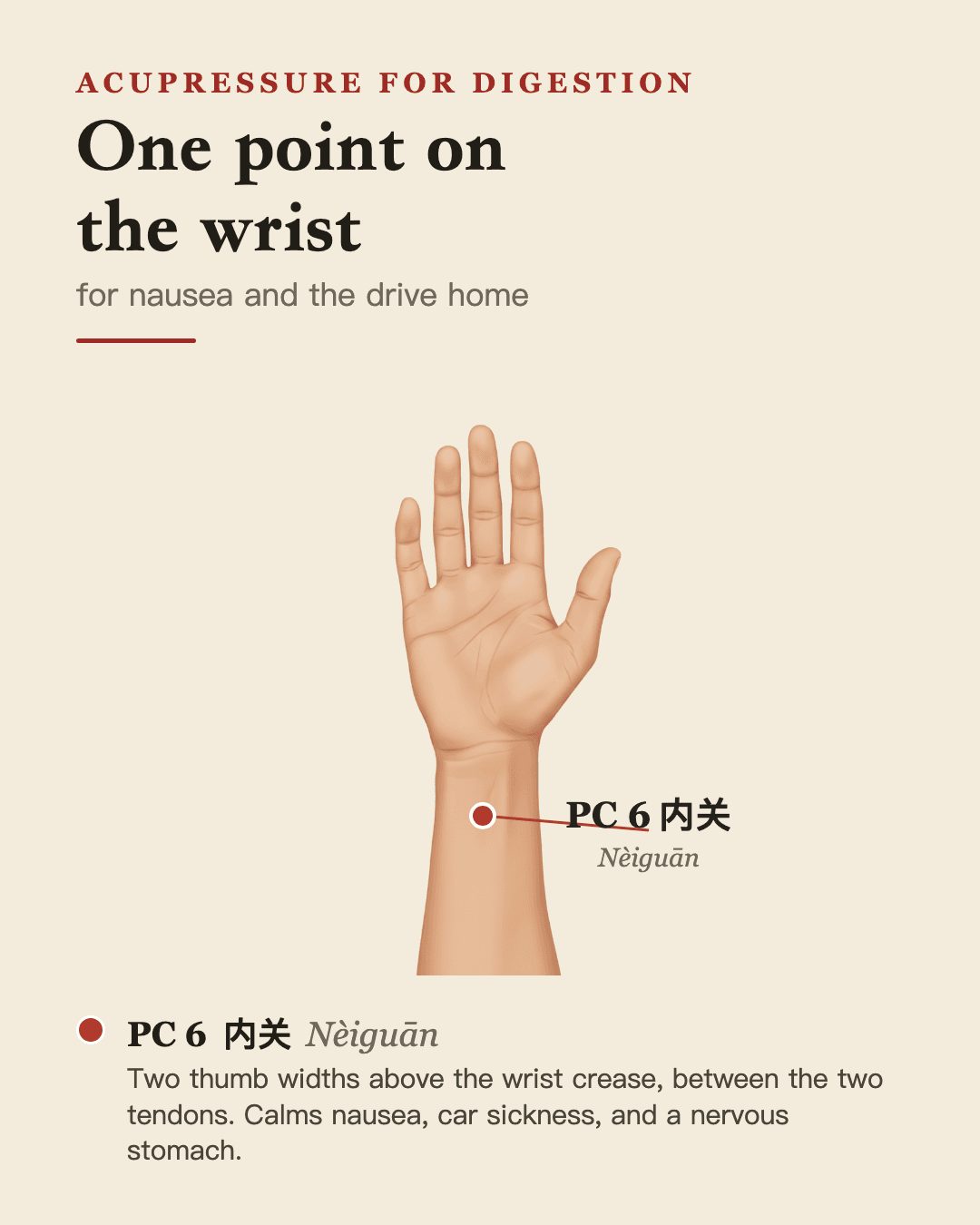
PC 6, Neiguan, shown on the inner forearm above the wrist crease
PC 6, Neiguan: an inner-forearm point used in traditional digestive treatment.

Upper abdominal pain or burning can have several causes. A medical assessment may include checking medications, testing for H. pylori infection or other investigations. When no underlying disease explains persistent symptoms, the diagnosis may be functional dyspepsia. A normal scope alone does not explain every symptom. NIDDK explains the assessment.

Meal-related fullness has evidence in a defined type of indigestion
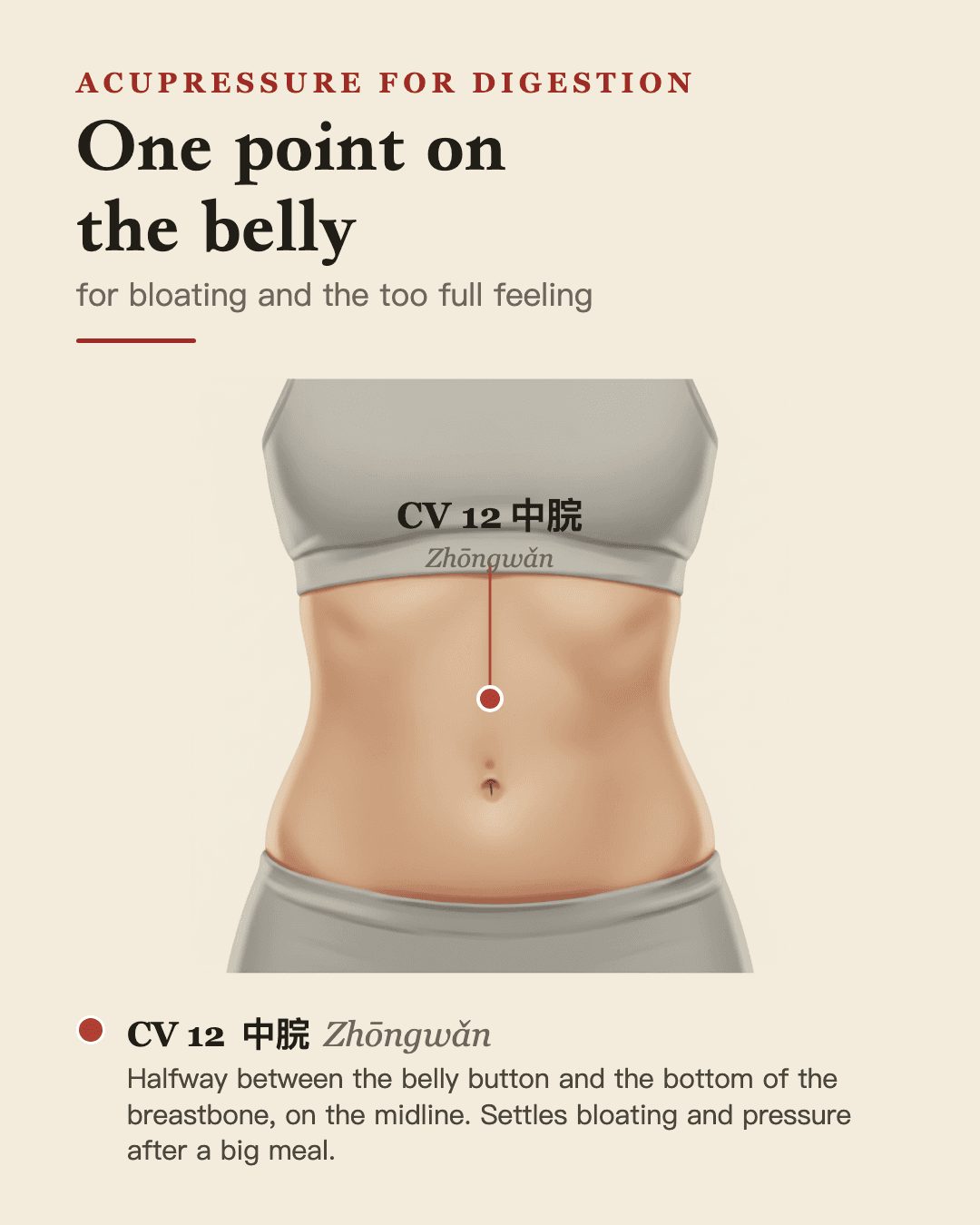
CV 12, Zhongwan, shown between the navel and the lower end of the breastbone
CV 12, Zhongwan: an abdominal point used in functional-dyspepsia trials.

Feeling full before finishing a meal or uncomfortably full afterwards can be part of postprandial distress syndrome, a subtype of functional dyspepsia. In a 2020 Chinese trial, 278 adults aged 18 to 65 with that diagnosis received 12 acupuncture or sham sessions over four weeks. The estimated overall response was 83.0% versus 51.6%; complete disappearance of the three main symptoms was less common, at 27.8% versus 17.3%. Benefits persisted during the 12-week follow-up, but outcomes were self-reported and 18% did not complete the final assessment.

A heavy meal is different from persistent indigestion
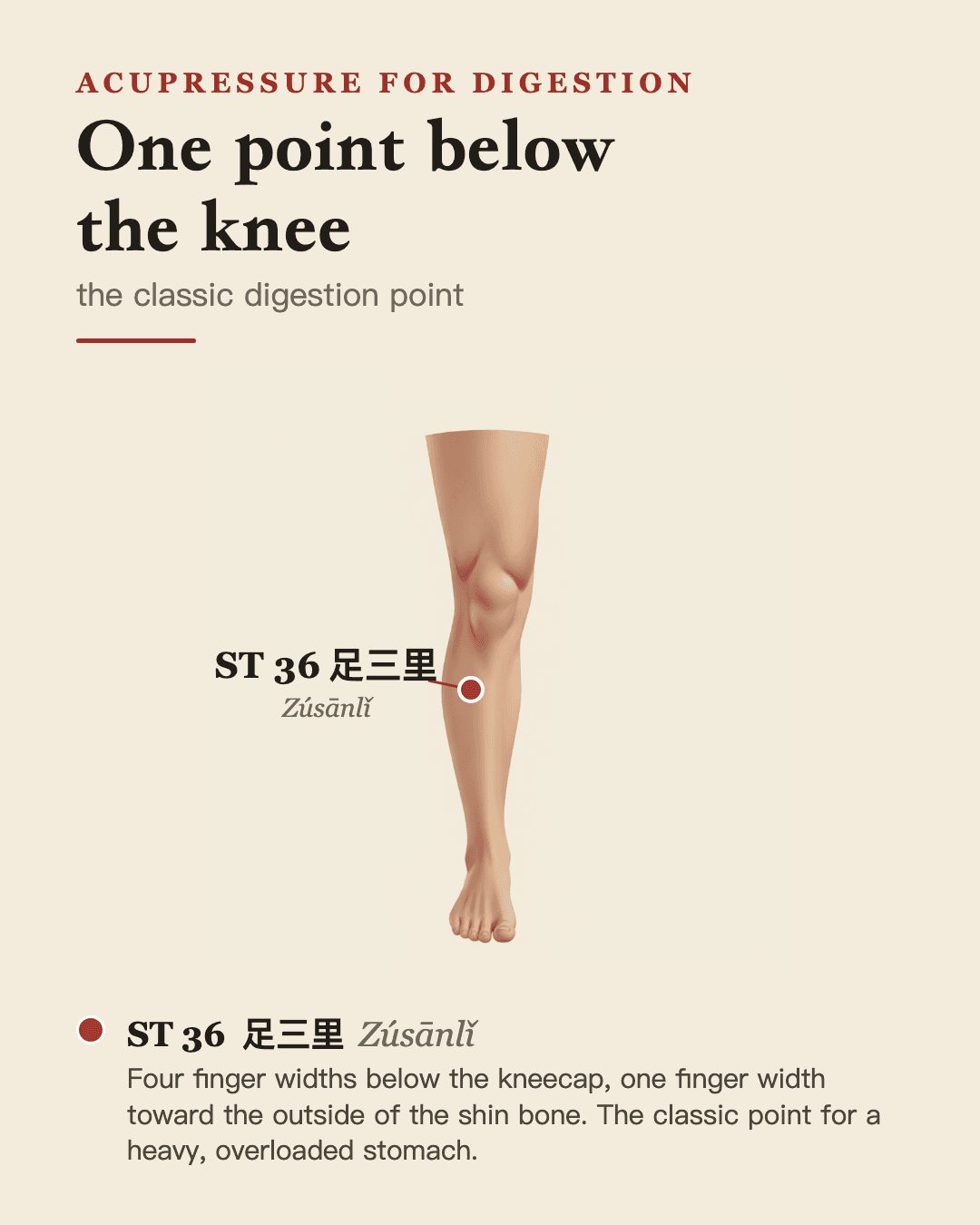
ST 36, Zusanli, shown below the knee beside the shin
ST 36, Zusanli: a leg point used in traditional digestive treatment.

Occasional discomfort after a large meal does not establish a chronic digestive disorder. Chinese medicine calls one related pattern food stagnation; it does not mean food is physically stuck. We can review portions, meal timing and your own triggers. Repeated symptoms deserve assessment rather than increasingly restrictive food rules.

Food timing and three points for the morning after

IBS treatment depends on whether diarrhoea or constipation predominates

IBS involves recurring abdominal pain related to bowel movements or a change in stool frequency or form. Diarrhoea-predominant, constipation-predominant and mixed IBS are distinct subtypes. The 2025 Chinese integrative-medicine consensus considers these subtypes alongside traditional patterns and includes acupuncture among treatment options.

The 2025 ACTION trial enrolled 280 people with diarrhoea-predominant IBS at six Chinese hospitals. After 15 sessions over six weeks, 57.9% in the acupuncture group met a combined abdominal-pain and diarrhoea response measure, versus 41.4% with sham treatment. This result does not establish the same benefit for constipation-predominant or mixed IBS.

Electroacupuncture has been studied for severe functional constipation

Constipation can involve hard stools, straining or a sense of incomplete emptying as well as infrequent bowel movements. In a 2016 trial at 15 Chinese hospitals, 1,075 people with chronic severe functional constipation received 28 sessions of electroacupuncture or sham treatment over eight weeks. During treatment, 31.3% versus 12.1% averaged at least three complete spontaneous bowel movements a week, meaning a complete movement without rescue treatment. The trial excluded serious underlying causes and did not test a short course for occasional constipation.

Blood in the stool, unexplained weight loss, difficulty swallowing, persistent vomiting or new severe pain need medical assessment before acupuncture.
The examination and your symptom diary answer different questions

Bring your diagnosis, medication list and a picture of a usual week

I ask when symptoms occur, what you eat, how you sleep and whether stress or your menstrual cycle changes the pattern. Bring any diagnosis, test results and medication list. We agree on what matters most to track, such as fullness after meals, pain, stool form or complete bowel movements.

During the examination I check for tenderness and tension around the abdomen and ask what you feel. A change in tenderness during a visit can inform the next step, but it does not show by itself that IBS, constipation or indigestion has improved. Your symptoms between visits are the main measure.

Video: the examination

Visit frequency depends on the condition and the treatment being tested

The studies above used different courses: four weeks for meal-related functional dyspepsia, six for diarrhoea-predominant IBS and eight for severe functional constipation. We choose a schedule for your diagnosis, goals and response.

A smaller 2023 Chinese trial in 90 people with functional dyspepsia compared three visits a week, one visit a week and no treatment for four weeks. More frequent treatment performed better in that study. It does not prove that three visits are necessary for IBS or constipation. We agree on a feasible schedule and a review point, then change or stop treatment if the benefit is not worthwhile.

Herbs are a separate treatment decision, with a review of ingredients, medications and side effects. The 2025 TCM guideline for functional dyspepsia reviews treatment options for adults with that diagnosis. Your existing medical care continues alongside any acupuncture or herbal treatment.

Cheek-acupuncture nausea research comes from surgical care

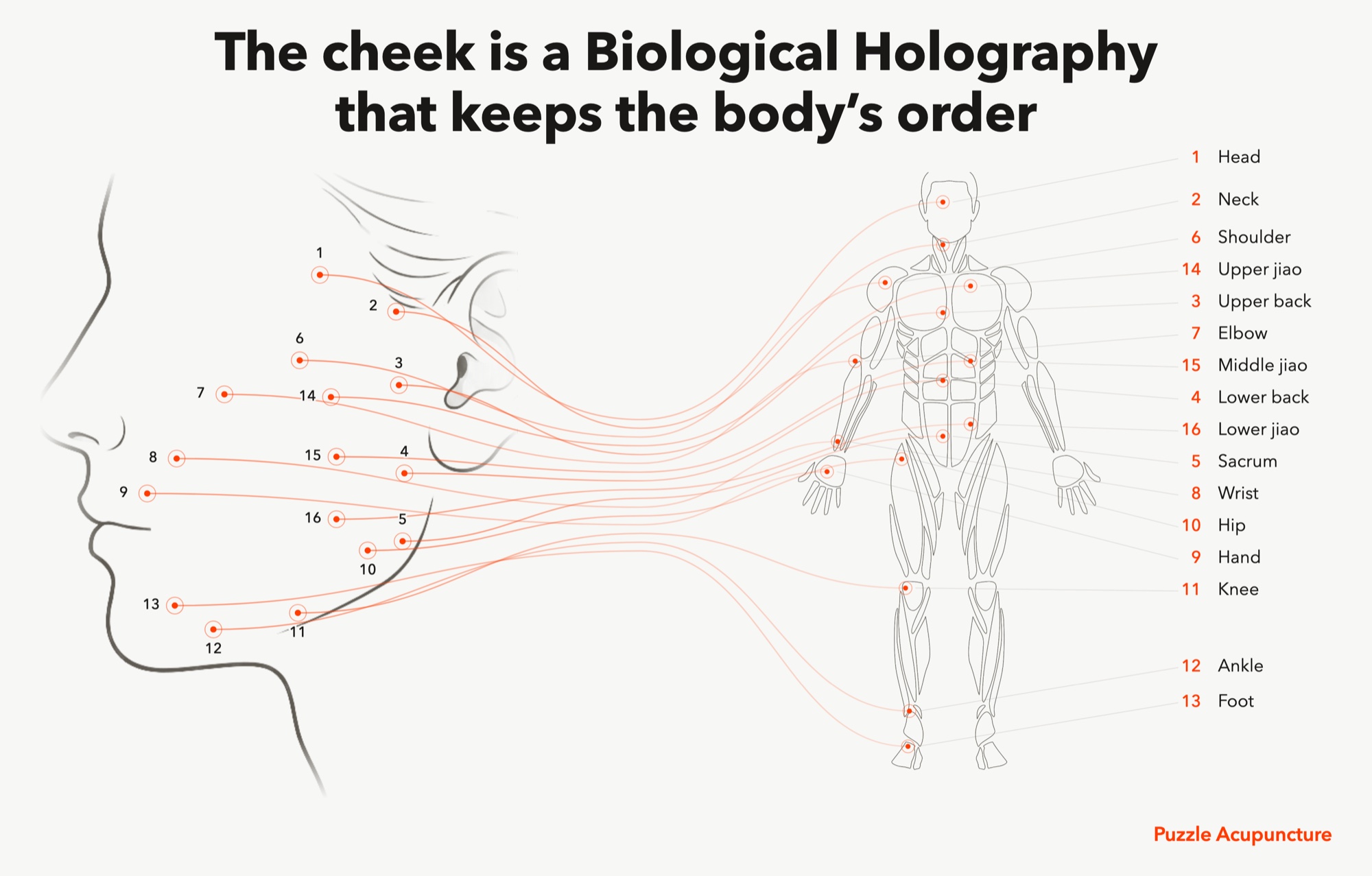
Illustration pairing a drawn profile of a face with a drawn human body. Numbered points on the cheek are joined by fine orange lines to the region each one stands for: head, neck, shoulder, upper jiao, upper back, elbow, middle jiao, lower back, lower jiao, sacrum, wrist, hip, hand, knee, ankle and foot.

A standardised map of points on each cheek, needled shallowly, a few at a time, to treat pain elsewhere in the body. It is not cosmetic facial acupuncture. Most describe it as lighter than ordinary needling, because the needles are shallow and few.

I hold the Level 3 certificate in cheek acupuncture. It is one technique we can discuss when abdominal needling is uncomfortable or unwelcome.

A 2024 Chinese trial studied cheek acupuncture before anaesthesia in adults aged 65 to 80 having stomach-cancer surgery. That setting is different from nausea in an outpatient digestive visit. It does not establish immediate relief for IBS, functional dyspepsia or unexplained nausea.

How cheek acupuncture works

FSN may address accompanying muscle pain, not the bowel diagnosis

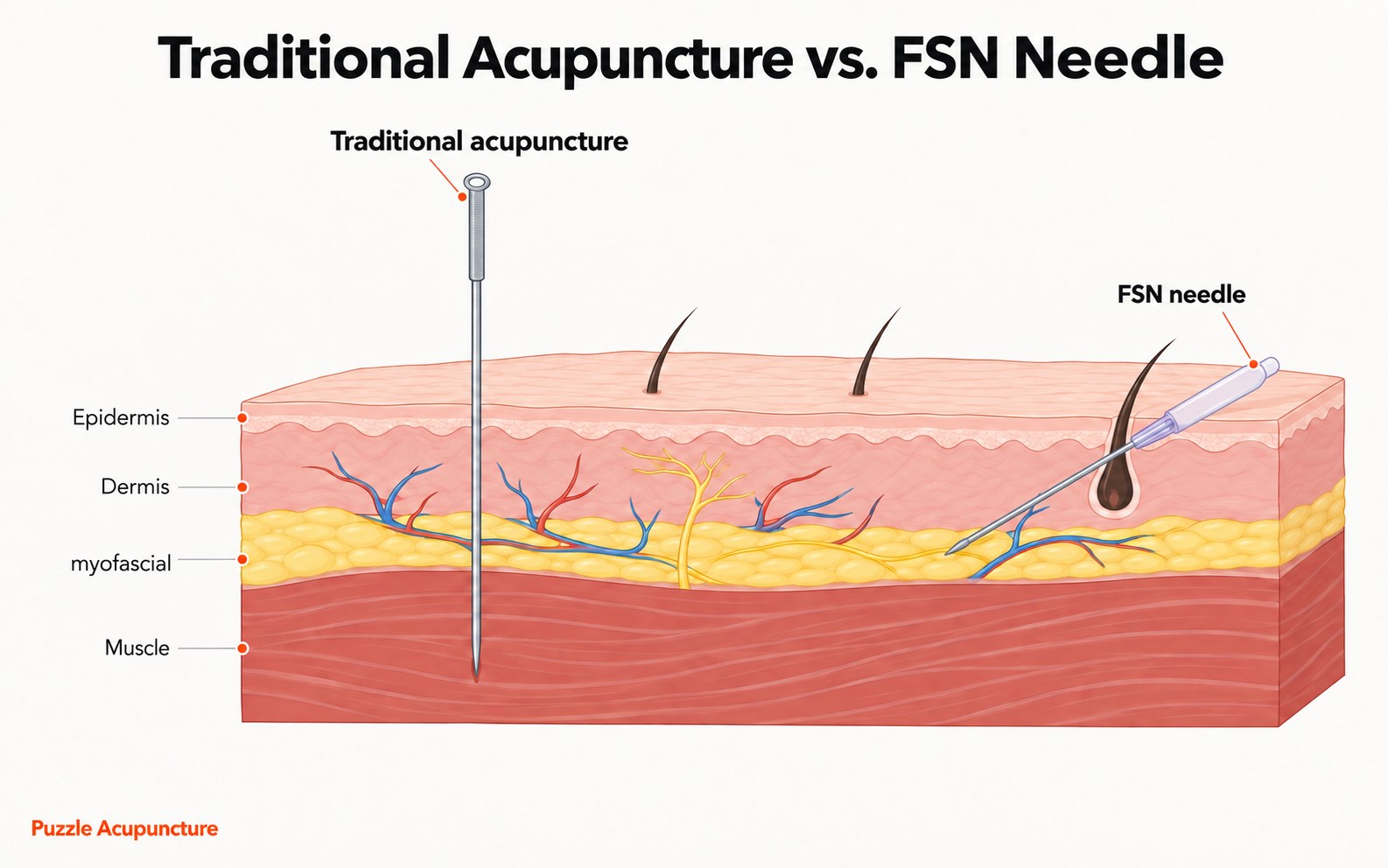
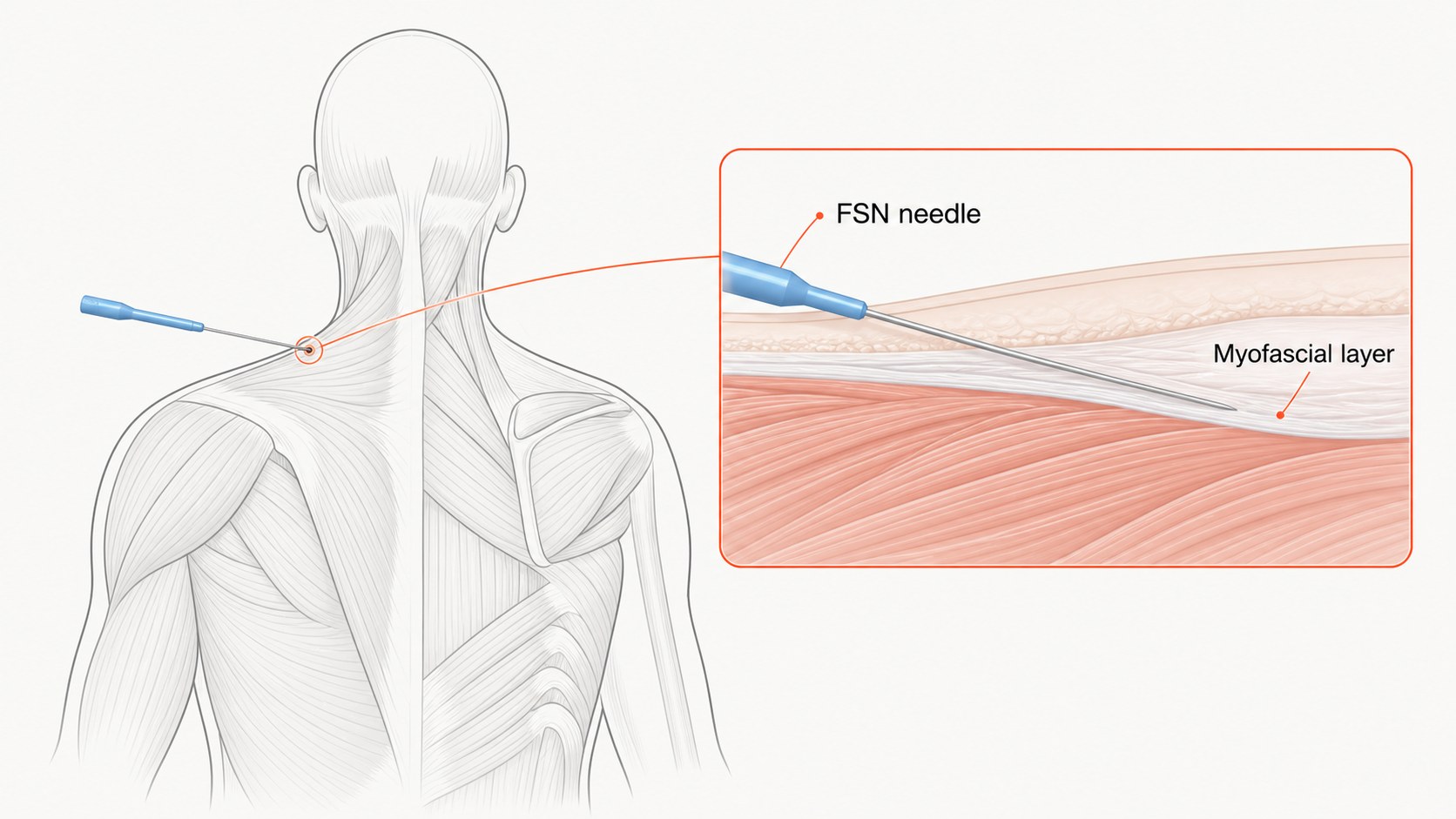
Illustration of the muscles of the upper back seen from behind, with an FSN needle entering at the top of the shoulder. An enlarged cross-section beside it shows the needle lying flat in the myofascial layer between the skin and the muscle. Cross-section of skin comparing two needles. A traditional acupuncture needle goes straight down through epidermis, dermis and myofascial layer into the muscle. The FSN needle enters at a shallow angle and stops in the layer above the muscle.
FSN needling stays beneath the skin and above the muscle.

FSN is Fu's Subcutaneous Needling, developed in China in the mid-1990s. The needle goes in at a shallow angle and stays in the loose layer under the skin, above the muscle. I sweep it gently side to side while guiding you through specific movements, and reassess movement. I hold the FSN certificate.

I may consider it for a painful or tight muscle area that accompanies your digestive symptoms, then check whether movement or discomfort changes.

The digestive trials above did not test FSN. Improvement in muscle pain cannot be assumed to treat gastritis, bowel motility or IBS.

How FSN needling works

Frequently Asked Questions

Does it hurt?

Less than people expect. The needles are about the width of a human hair, and I use fewer of them than most practices. Most people describe a dull heaviness at the point rather than pain, and a fair number fall asleep on the table.

How soon will I know if it is working?

We agree on a review point based on the diagnosis and the treatment plan. The trials described here assessed different conditions over four to eight weeks; they do not establish one response time for all digestive symptoms or immediate relief from cheek acupuncture.

We track the symptoms that brought you in and their effect on daily life. Less tenderness on the table can be useful, but progress needs to show up between visits too.

Do you treat IBS, or only bloating?

I see people with both. Bloating is a symptom; IBS and functional dyspepsia are diagnoses with different research and treatment plans. Bring your diagnosis and any tests you have had. New or worsening symptoms may need medical assessment before we add acupuncture.

Do I keep taking my medication?

Yes, unless the person who prescribed it says otherwise. I do not adjust prescriptions and nothing here is a reason to stop one. If reducing a medication is the goal, that conversation stays with your prescriber.

Will you put me on herbs, and do I have to give up coffee and cold drinks?

Herbs are optional and need a medication and safety review. Food advice starts with your symptoms and usual meals, not a standard list of bans. We can look for individual triggers without assuming that coffee, cold drinks or a whole food group must go.

How many needles?

Fewer than you are imagining. Point selection is deliberate and minimal, and most people are surprised how little is used. Where they go depends on what the exam finds rather than on where it hurts. If needles in the belly worry you, say so and we will start with points on the legs and arms, or with the cheek technique, which uses the fewest of all.

What does it cost?

The first consult is free. A new patient visit is $255 for 75 minutes and follow-ups are $205 for 60 minutes. Current rates are on the pricing page.

Tell me what your gut is doing

The consult is free. We go through your history, what you are taking, what the scope found if you have had one, and where acupuncture fits.

Related reading

Free Consult Google Map